
The “Superfood” Debate
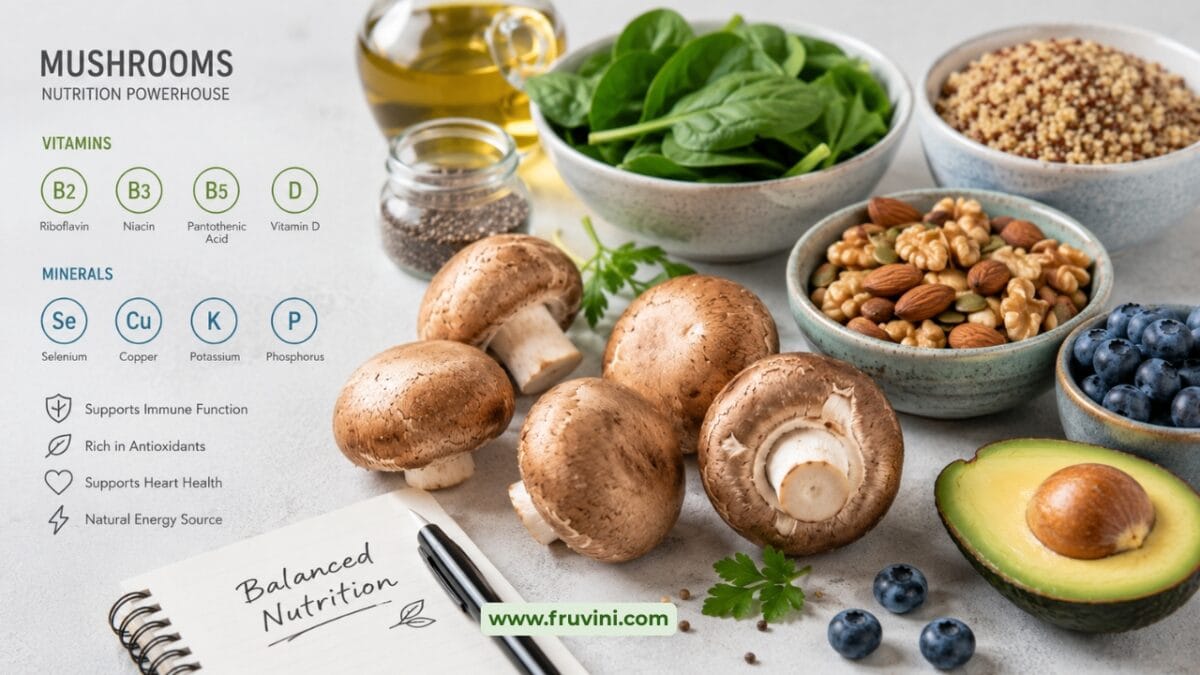
“Superfood” is a term you’ve probably seen everywhere—used to describe foods that are exceptionally healthy or packed with nutrients. In recent years, mushrooms have increasingly been included in this category, often promoted for their nutritional value and potential health benefits.
To understand the broader wellness interest around fungi, explore these top medicinal mushrooms and their benefits.
But are mushrooms truly a superfood, or is that label more about perception than science?
The answer isn’t as straightforward as it might seem. While mushrooms do contain important nutrients and unique compounds, the term “superfood” itself has no official scientific definition. This makes it important to look beyond the label and understand what mushrooms actually offer from a nutritional perspective.
In this article, we’ll take a closer, evidence-based look at mushrooms—breaking down their nutritional profile, comparing them with other commonly labeled superfoods, and examining whether they truly deserve that title.
👉 Instead of relying on labels, let’s focus on facts.
What Is a Superfood? (Definition vs Reality)
The term “superfood” is widely used in media and marketing, but it’s important to understand one key fact:
👉 there is no official scientific or regulatory definition of a superfood.
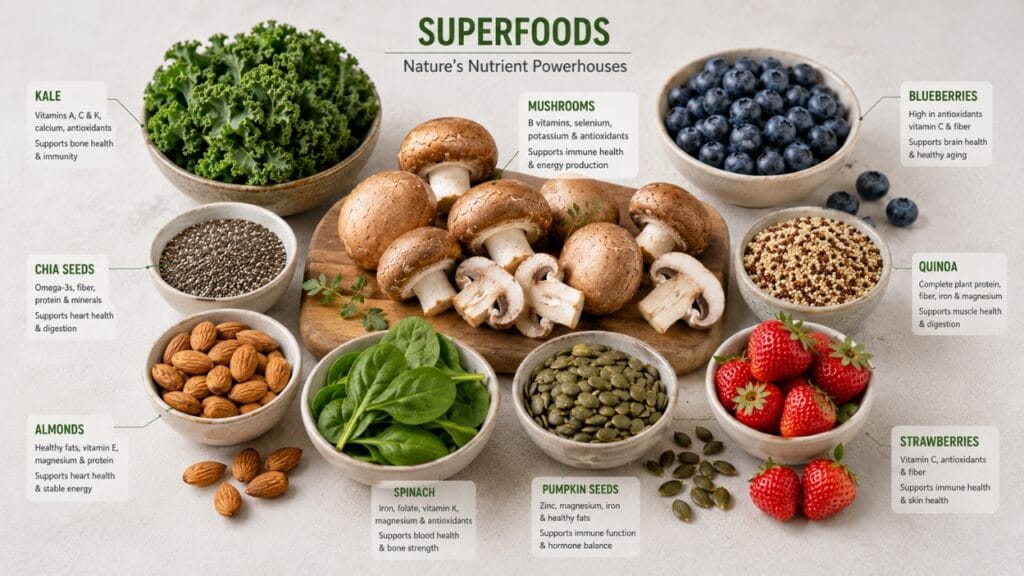
The term “superfood” is widely used in marketing, but organizations like the
British Heart Foundation explain that there is no official scientific definition for it.
The Origin of the Term
“Superfood” started as a marketing term to highlight foods that are rich in nutrients or associated with health benefits.
- Often used to promote specific foods
- Popular in health and wellness trends
- Not based on standardized scientific criteria
👉 More marketing than science.
What Nutrition Science Actually Focuses On
Instead of labels, nutrition science looks at nutrient density and dietary patterns.
- Foods rich in vitamins, minerals, and fiber
- Overall dietary balance
- Variety of nutrient sources
👉 No single food defines a healthy diet.
Why the Term Can Be Misleading
Calling something a “superfood” can create unrealistic expectations.
- Suggests one food is enough for health
- Ignores the importance of a balanced diet
- Oversimplifies complex nutrition
👉 Health comes from patterns, not single foods.
Where Mushrooms Fit In
Mushrooms are often labeled as a superfood because they are nutrient-rich and low in calories, but that doesn’t automatically make them unique compared to other healthy foods.
👉 The real question is not “Are they a superfood?”
👉 It’s “What do they actually provide nutritionally?”
Key Takeaway
“Superfood” is a useful but non-scientific term. To understand the value of mushrooms, it’s better to focus on their actual nutritional content rather than the label.
👉 Facts matter more than labels.
Nutritional Breakdown of Mushrooms
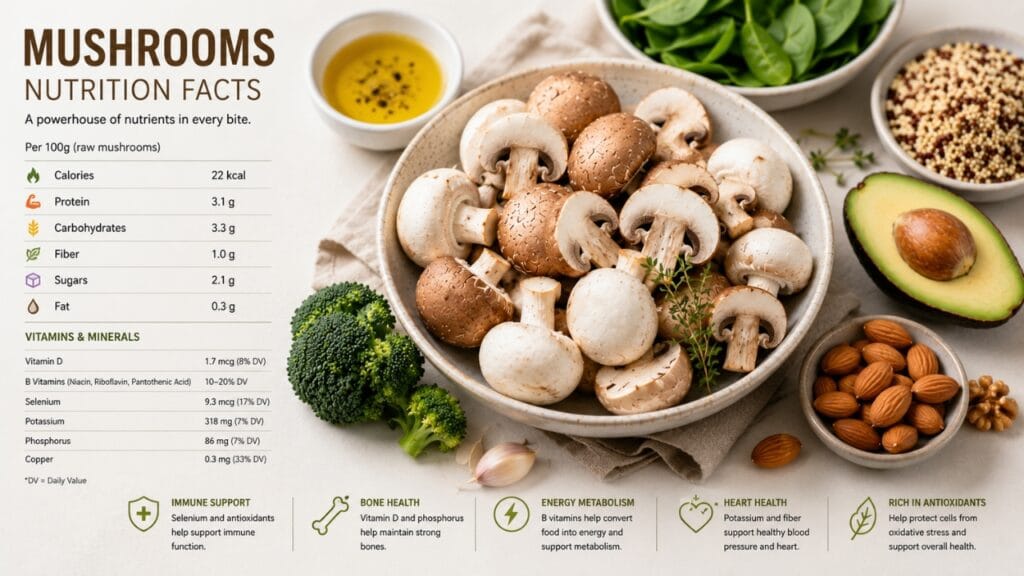
To understand whether mushrooms deserve the “superfood” label, we need to look at their actual nutritional composition. Instead of relying on claims, this section focuses on what mushrooms truly provide.
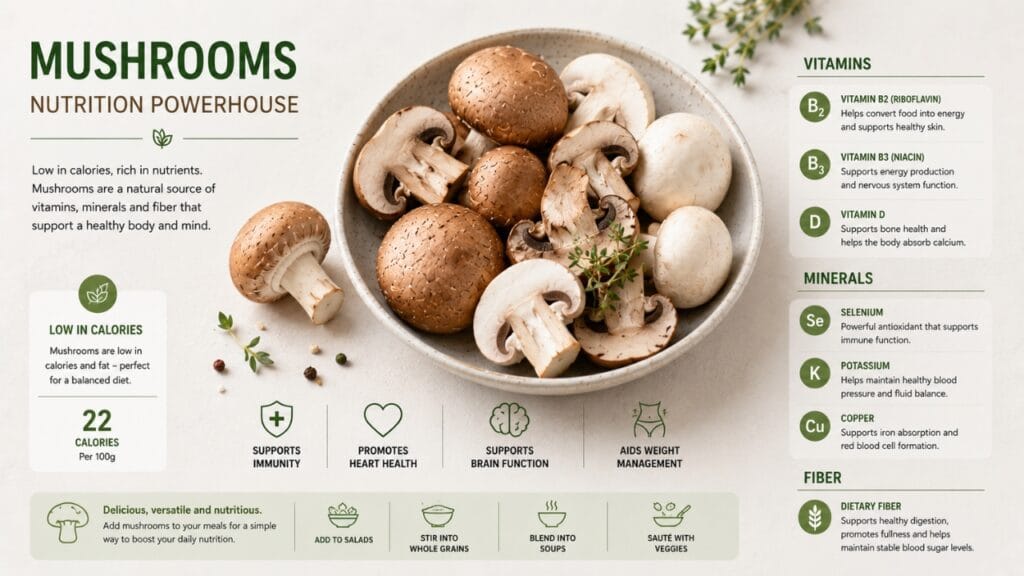
You can explore official mushroom nutrition data through the
USDA FoodData Central, which provides detailed nutritional information on foods.
1. Macronutrients (Low-Calorie, Light Food)
Mushrooms are naturally low in calories and fat.
- Low calorie content
- Minimal fat
- Small amount of protein
👉 Suitable for light and balanced diets.
2. Vitamins (B-Complex and Vitamin D)
Mushrooms provide several essential vitamins.
- B vitamins (B2, B3, B5) → Help with energy metabolism
- Vitamin D (when exposed to sunlight) → Supports bone health
👉 Useful for daily nutritional support.
3. Minerals (Selenium, Potassium)
They also contain important minerals.
- Selenium → Supports immune function
- Potassium → Helps maintain fluid balance
👉 Important for internal body functions.
You can also explore the detailed health benefits of mushroom powder to understand how mushroom nutrients are commonly consumed.
4. Unique Compounds (Ergothioneine & Beta-Glucans)
Mushrooms stand out for certain bioactive compounds.
- Ergothioneine → A naturally occurring antioxidant
- Beta-glucans → Associated with immune support
👉 These add functional value beyond basic nutrition.
The quality of these compounds depends heavily on cultivation methods, especially in controlled environment mushroom farming.
5. Fiber Content (Digestive Support)
Mushrooms provide dietary fiber that supports digestion.
- Helps gut health
- Aids digestion
- Contributes to satiety
👉 Supports overall dietary balance.
Key Takeaway
Mushrooms are nutrient-dense, low-calorie, and contain unique compounds, making them a valuable addition to a healthy diet.
👉 But nutrient-rich doesn’t automatically mean “superfood”.
How Mushrooms Compare to Other “Superfoods”
To evaluate whether mushrooms are truly a superfood, it helps to compare them with other foods commonly given that label. This gives a clearer picture of where mushrooms stand nutritionally.
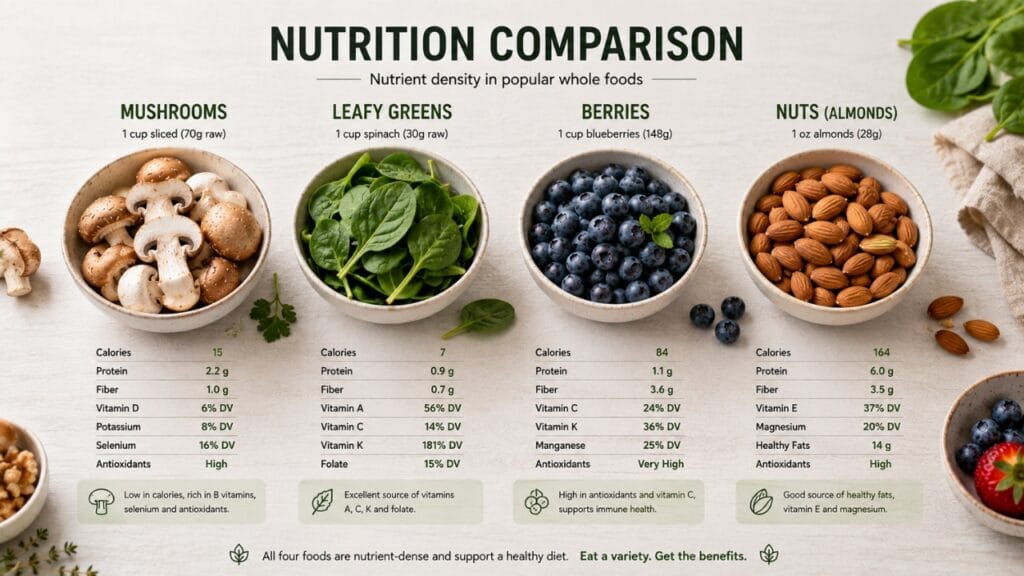
1. Mushrooms vs Leafy Greens
Leafy greens like spinach and kale are often considered classic superfoods.
- Leafy greens → High in vitamins A, C, and fiber
- Mushrooms → Lower in these vitamins but contain unique compounds like beta-glucans
👉 Different strengths, not direct competition
2. Mushrooms vs Berries
Berries are known for their antioxidant content.
- Berries → Rich in vitamin C and antioxidants
- Mushrooms → Contain different antioxidants like ergothioneine
👉 Both contribute differently to health
3. Mushrooms vs Nuts and Seeds
Nuts and seeds are nutrient-dense foods.
- Nuts/seeds → High in healthy fats and protein
- Mushrooms → Low in fat and calories
👉 Mushrooms are lighter, not nutrient-dense in the same way
4. What This Comparison Shows
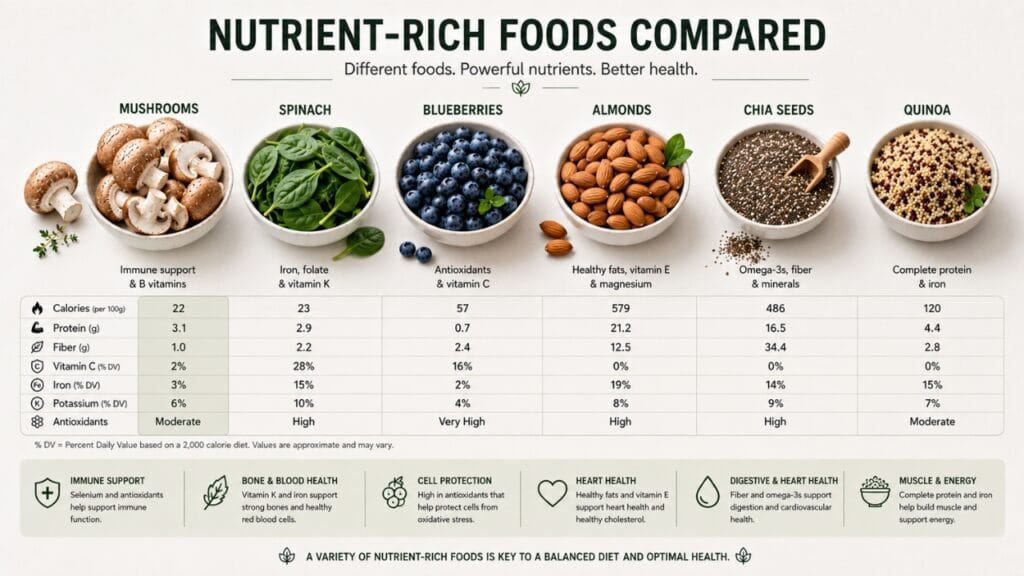
There is no single food that outperforms all others in every category.
- Mushrooms are low-calorie and functional
- Other “superfoods” may be more nutrient-dense in specific areas
- Each food contributes differently to a healthy diet
👉 Health comes from combining foods, not choosing one
If you want practical examples, here’s a guide on how to use mushrooms in daily diet effectively.
Key Takeaway
Mushrooms are not necessarily superior to other superfoods—but they offer unique benefits that complement a balanced diet.
👉 They are part of the solution, not the whole solution.
Functional Properties of Mushrooms
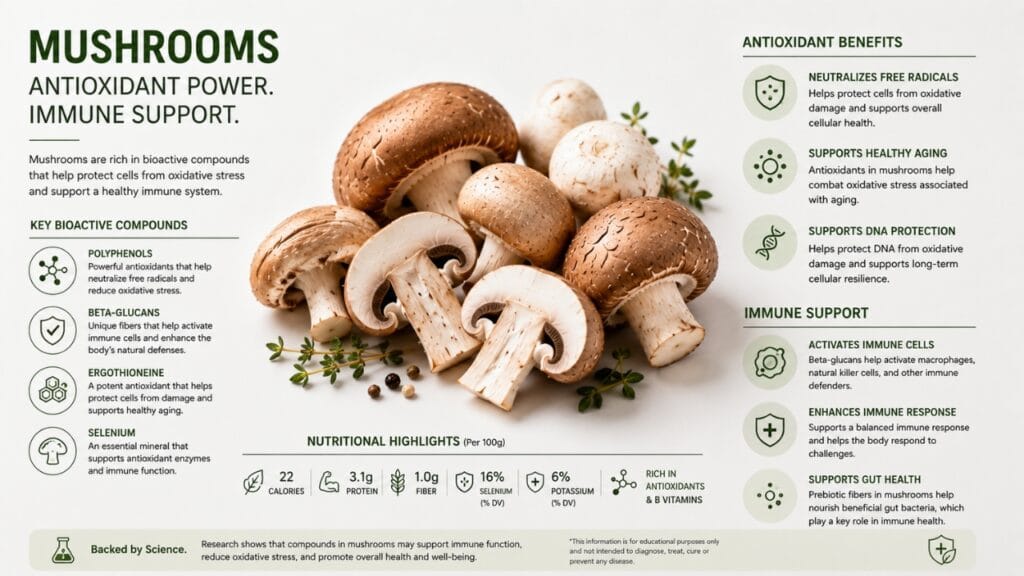
Beyond basic nutrition, mushrooms are often discussed for their functional properties—meaning they contain compounds that may support certain body functions. This is one of the main reasons they are frequently associated with the “superfood” label.
1. Antioxidant Properties
Mushrooms contain antioxidants, including a unique compound called ergothioneine.
- Helps reduce oxidative stress
- Supports cell protection
- Contributes to long-term health
👉 Different from common plant antioxidants.
2. Immune-Supporting Compounds
Certain compounds in mushrooms are linked to immune function.
- Beta-glucans interact with immune cells
- Support normal immune response
- Studied for their functional role
👉 Focus is on support, not stimulation.
3. Dietary Fiber and Gut Health
Mushrooms contribute to digestive health through fiber.
- Supports gut microbiome
- Aids digestion
- Helps maintain balance
👉 Important for overall health.
4. Low Energy Density (Weight-Friendly Food)
Mushrooms provide volume without many calories.
- Helps in portion control
- Supports weight management
- Adds bulk to meals without excess energy
👉 Useful in balanced diets.
Key Takeaway
Mushrooms stand out not because they are the most nutrient-dense food, but because they offer functional benefits that complement overall nutrition.
👉 Their value lies in how they support, not replace, a healthy diet.
Limitations: Where Mushrooms Fall Short
While mushrooms offer valuable nutrients and functional benefits, they are not a complete food. Understanding their limitations helps put their role in a balanced diet into perspective.
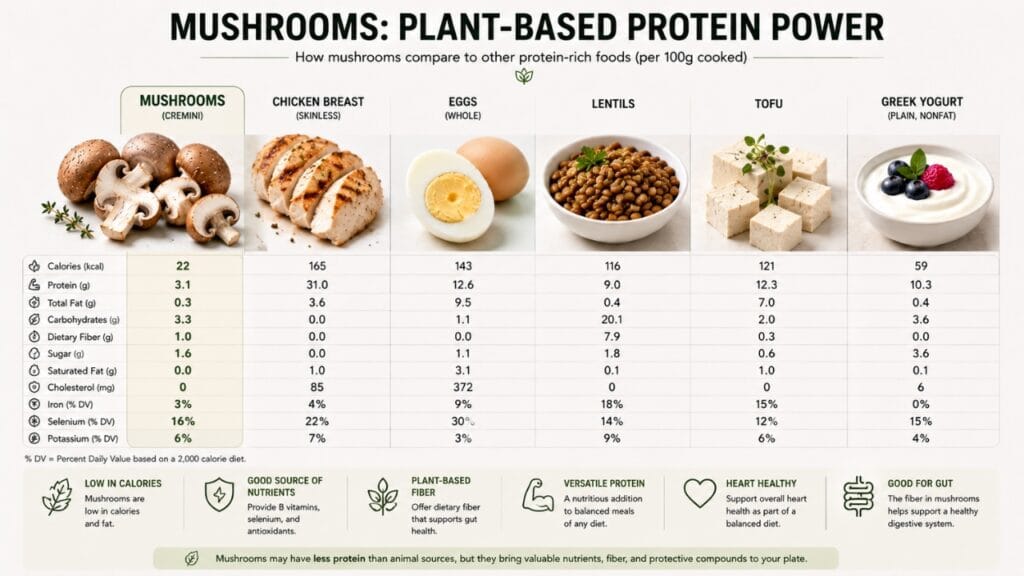
1. Not a High-Protein Food
Mushrooms contain some protein, but not in significant amounts.
- Lower protein compared to legumes, eggs, or dairy
- Not suitable as a primary protein source
- Works better as a supporting ingredient
👉 Complements protein, doesn’t replace it
2. Limited Calorie Density
Mushrooms are very low in calories.
- Not ideal for high-energy needs
- May not provide enough calories alone
- Needs to be combined with other foods
👉 Good for balance, not for energy needs
3. Nutrient Range Is Not Complete
No single food provides everything your body needs.
- Missing certain essential nutrients
- Needs combination with other food groups
- Works best in a diverse diet
👉 Variety matters more than one food.
4. Benefits Depend on Overall Diet
The impact of mushrooms depends on how they are used.
- Benefits are part of a larger dietary pattern
- Not effective in isolation
- Works best with consistent healthy habits
👉 Context is everything.
For a broader understanding of mushroom nutrition and quality, see this guide on mushroom spawn quality.
Key Takeaway
Mushrooms are beneficial, but they are not a standalone solution. Their real value comes from how they fit into a balanced and varied diet.
👉 No single food replaces overall nutrition.
So, Are Mushrooms Really a Superfood?
After looking at the definition, nutritional data, comparisons, and limitations, the answer becomes clearer:
👉 Mushrooms can be considered a “superfood” in a general sense—but not in a strict scientific one.
Why Mushrooms Can Be Seen as a Superfood
- They are low in calories and fat
- Provide important vitamins and minerals
- Contain unique compounds like ergothioneine and beta-glucans
- Offer functional benefits that support overall health
👉 They bring real value to a healthy diet
Why the Label Can Be Misleading
- “Superfood” is not a scientific category
- Mushrooms are not nutritionally complete
- Their benefits depend on how they are used in a diet
- No single food can replace balanced nutrition
👉 The label oversimplifies reality.
A More Accurate Perspective
Instead of asking whether mushrooms are a superfood, a better way to look at them is:
👉 They are a nutrient-rich, functional food that supports health when used consistently as part of a balanced diet.
Final Takeaway
Mushrooms are valuable, versatile, and beneficial—but not magical.
👉 Their strength lies in supporting your diet, not defining it.
Practical Perspective: How to Use Mushrooms in a Balanced Diet
Understanding the nutrition of mushrooms is useful—but the real value comes from how you include them in your daily meals. Instead of treating mushrooms as a “special” food, it’s better to use them as a supporting ingredient in a balanced diet.
1. Use Mushrooms as a Supporting Ingredient
Mushrooms work best when combined with other foods.
- Add to vegetable dishes
- Mix with grains like rice or pasta
- Combine with protein sources
👉 Enhances meals without replacing core nutrients.
2. Include Them in Daily Meals
You don’t need special recipes.
- Breakfast → omelets, sandwiches
- Lunch → curries, stir-fries
- Dinner → soups, sautéed dishes
👉 Easy to include across the day.
Beginners can also learn how oyster mushrooms are cultivated for fresher everyday use.
3. Combine with Other Nutrient Sources
Balance is key to nutrition.
- Pair with protein (lentils, eggs, etc.)
- Include healthy fats
- Add variety of vegetables
👉 Complements—not replaces—other foods.
4. Use Different Forms (Fresh or Powder)
Mushrooms can be used in multiple forms.
- Fresh mushrooms for cooking
- Powder for drinks or meals
- Easy to integrate into routine
👉 Flexible and convenient.
Key Takeaway
Mushrooms are most effective when used consistently as part of a varied diet, not as a standalone solution.
👉 Think integration, not replacement.
Quick Summary
- Mushrooms are nutrient-rich and low in calories, making them a healthy addition to meals
- They contain vitamins, minerals, and unique compounds like beta-glucans and ergothioneine
- The term “superfood” is not scientific—it’s more of a marketing label
- Compared to other superfoods, mushrooms offer different benefits, not superior ones
- They are not a complete food and should be part of a balanced diet
- Their value comes from supporting overall nutrition, not replacing it
👉 Bottom line: Mushrooms are a functional, healthy food—but not a magic solution
Explore natural mushroom-based products on the Fruvini product page for practical daily use.
FAQs on Mushrooms as a Superfood
Are mushrooms considered a superfood?
Mushrooms are often called a superfood because they are nutrient-rich and contain beneficial compounds. However, the term “superfood” is not scientifically defined.
Are mushrooms healthy to eat every day?
Yes, mushrooms can be included in a daily diet as part of a balanced meal plan. They are low in calories and provide useful nutrients.
Which mushroom is the most nutritious?
Different mushrooms offer different benefits. For example, oyster mushrooms are nutrient-rich, while medicinal mushrooms like reishi and lion’s mane are valued for functional compounds.
Do mushrooms provide enough protein?
Mushrooms contain some protein, but not enough to be a primary source. They should be combined with other protein-rich foods.
Are mushrooms good for weight loss?
Yes, mushrooms are low in calories and can help add volume to meals, making them useful in weight management diets.
Can mushrooms replace vegetables in a diet?
No, mushrooms should complement vegetables, not replace them. A balanced diet requires a variety of foods.
What makes mushrooms different from other foods?
Mushrooms contain unique compounds like ergothioneine and beta-glucans, which are not commonly found in many other foods.
How should I include mushrooms in my diet?
You can add mushrooms to everyday meals like curries, soups, stir-fries, or even use mushroom powder in drinks.

Leave a Reply