
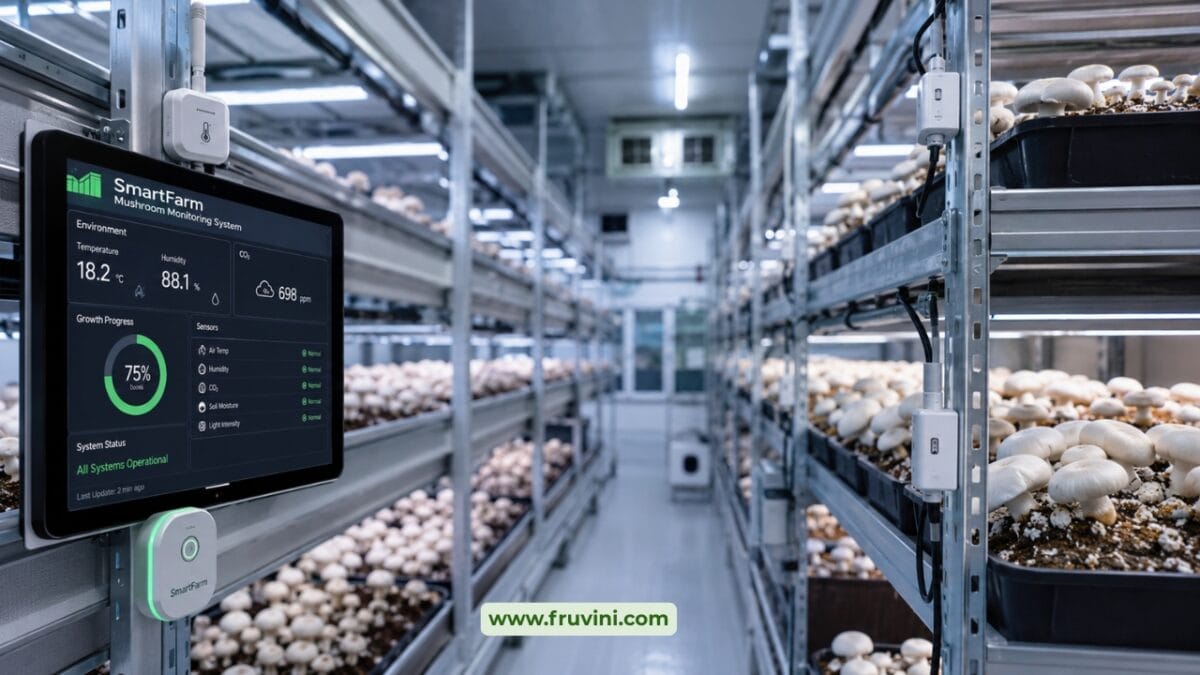
The Rise of Smart Mushroom Farming
Mushroom farming has always depended heavily on precision. Unlike many traditional crops, mushrooms require carefully controlled environmental conditions to grow successfully. Even small fluctuations in temperature, humidity, airflow, or carbon dioxide levels can affect yield, quality, and contamination risk.
As demand for high-quality mushrooms continues to grow, farmers are increasingly looking for smarter ways to manage cultivation environments more efficiently and consistently. This is where IoT (Internet of Things) in mushroom farming is beginning to transform the industry.
By using connected sensors, automated climate systems, and real-time monitoring tools, SmartFarm technology allows growers to track and control cultivation conditions with far greater accuracy than manual methods alone. Instead of relying only on observation and routine adjustments, farmers can now use data-driven systems to improve productivity and reduce operational challenges.
From small indoor farms to large commercial cultivation units, IoT is helping mushroom farming become more precise, scalable, and technology-driven.
Modern cultivation environments are becoming increasingly advanced, especially in controlled environment mushroom farming systems.
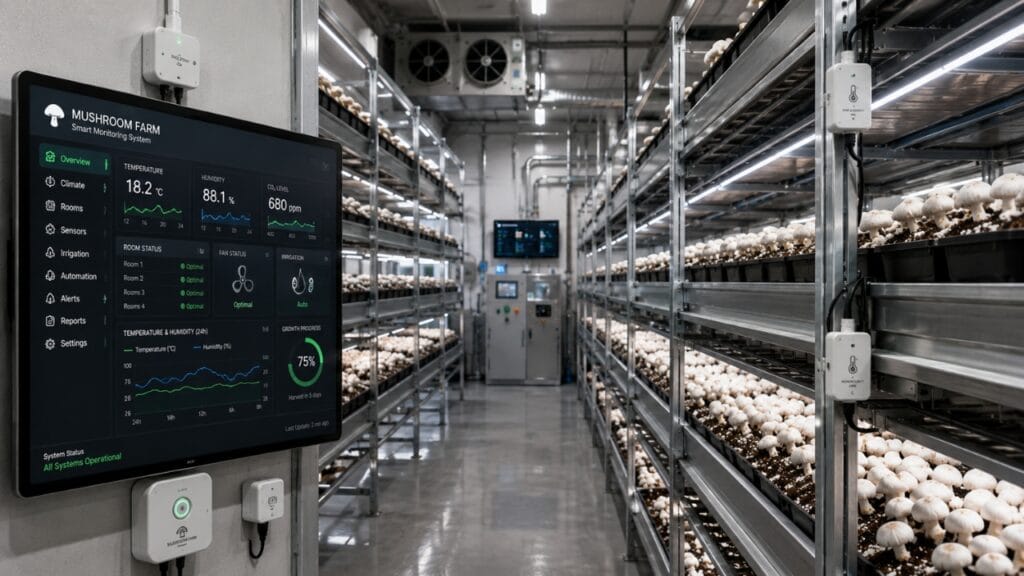
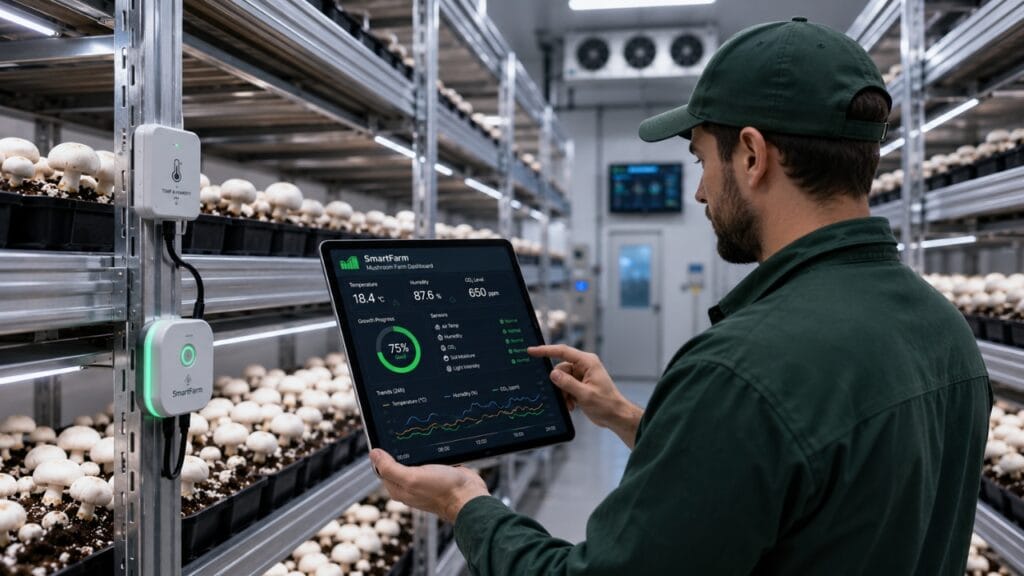
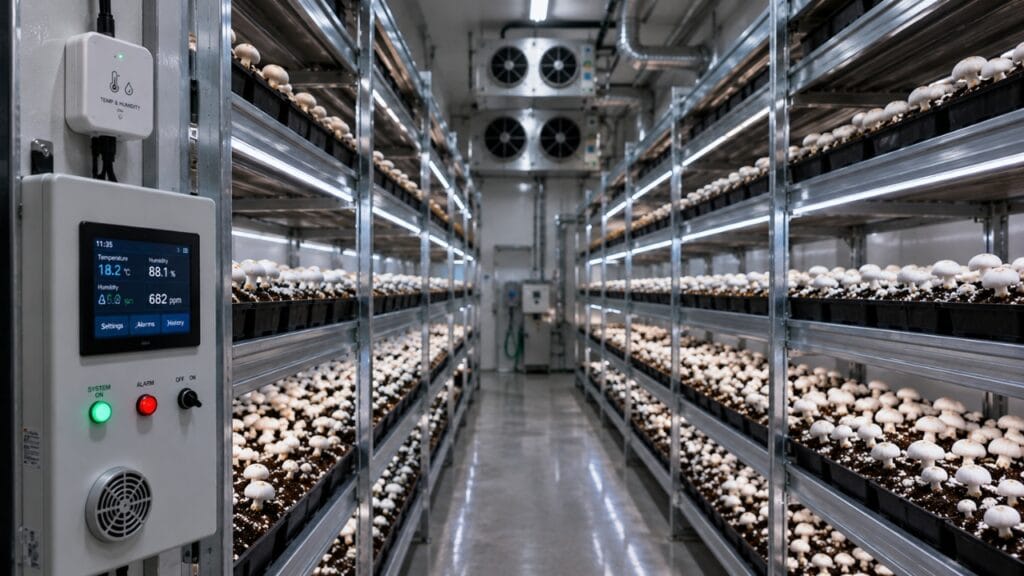
In this article, we’ll explore how IoT works in mushroom farming, the technologies behind SmartFarm systems, their benefits and limitations, and what the future of smart mushroom cultivation may look like.
What is IoT in Mushroom Farming?
IoT, or the Internet of Things, refers to a network of connected devices and sensors that collect, share, and analyze data in real time. In mushroom farming, IoT technology is used to monitor and control cultivation conditions automatically and with greater precision.
Instead of relying entirely on manual observation, growers can use smart systems to continuously track important environmental factors inside growing rooms.
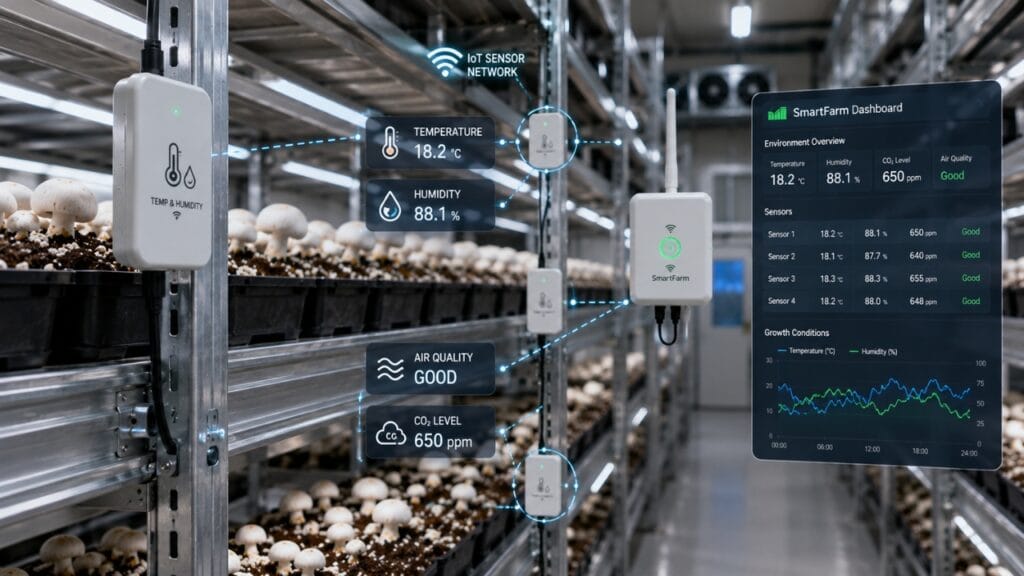
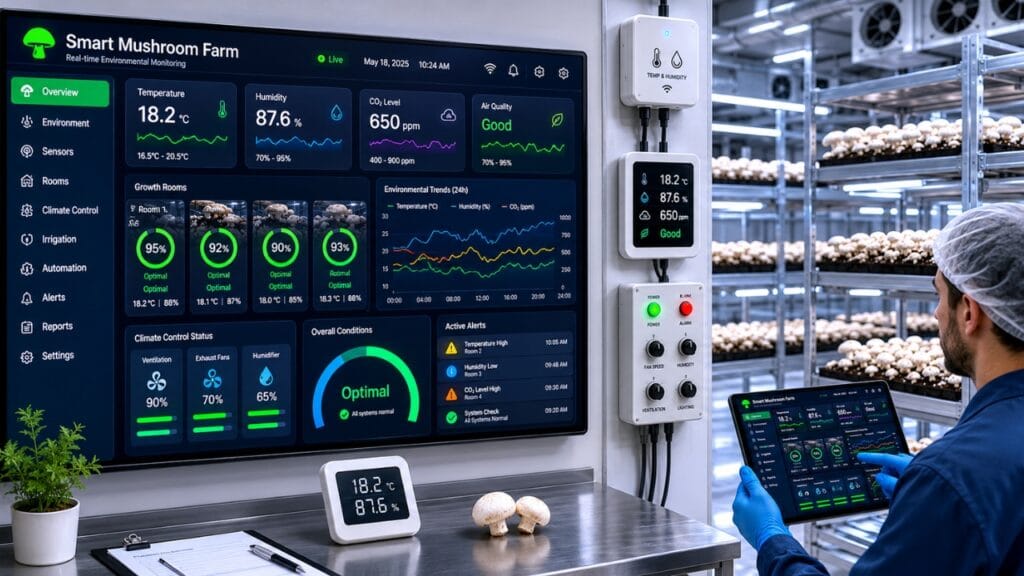
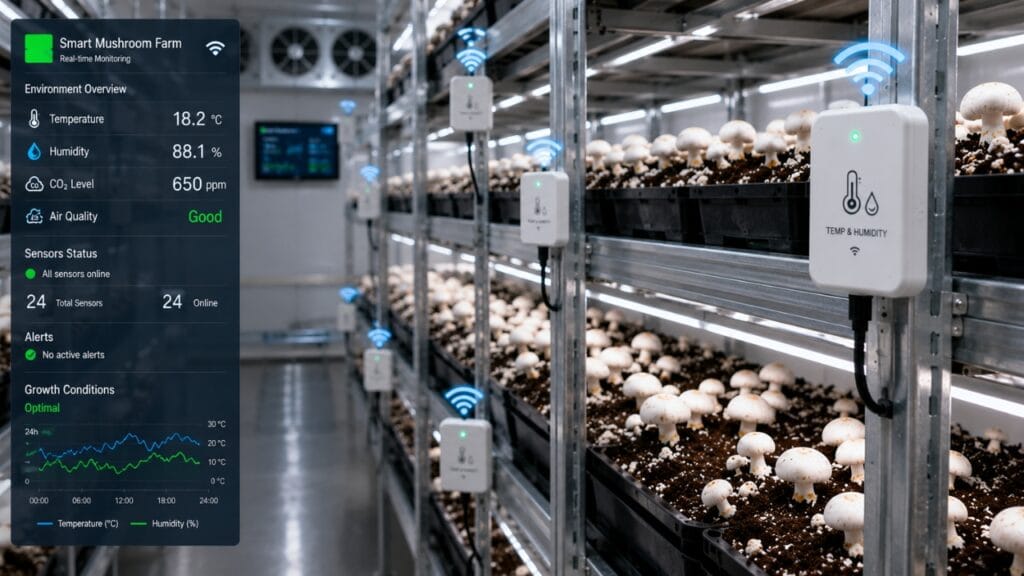
The broader role of IoT in agriculture is also discussed by the IBM IoT in Agriculture resource, which explains how connected systems improve precision farming.
How IoT Works in Mushroom Farming
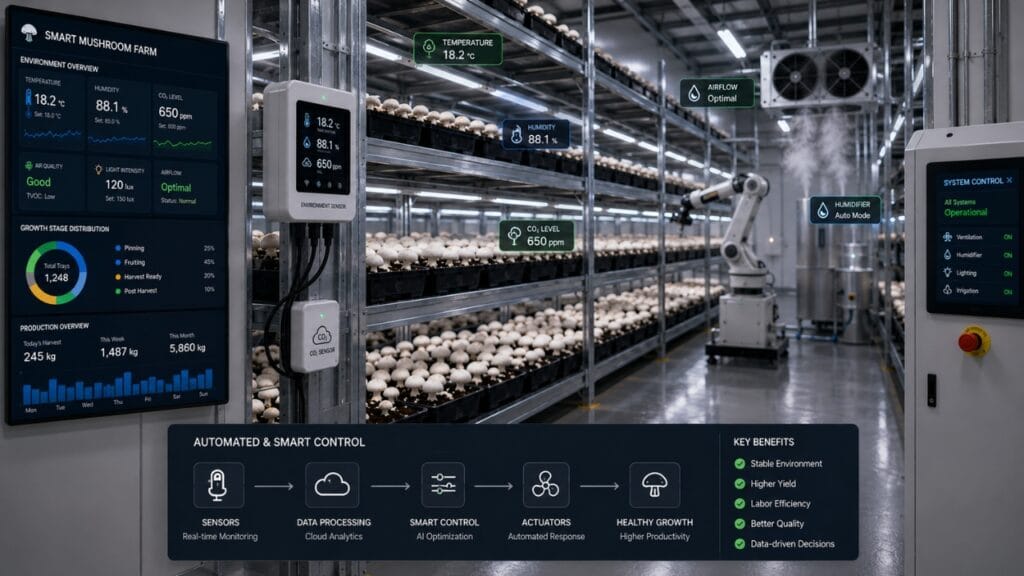
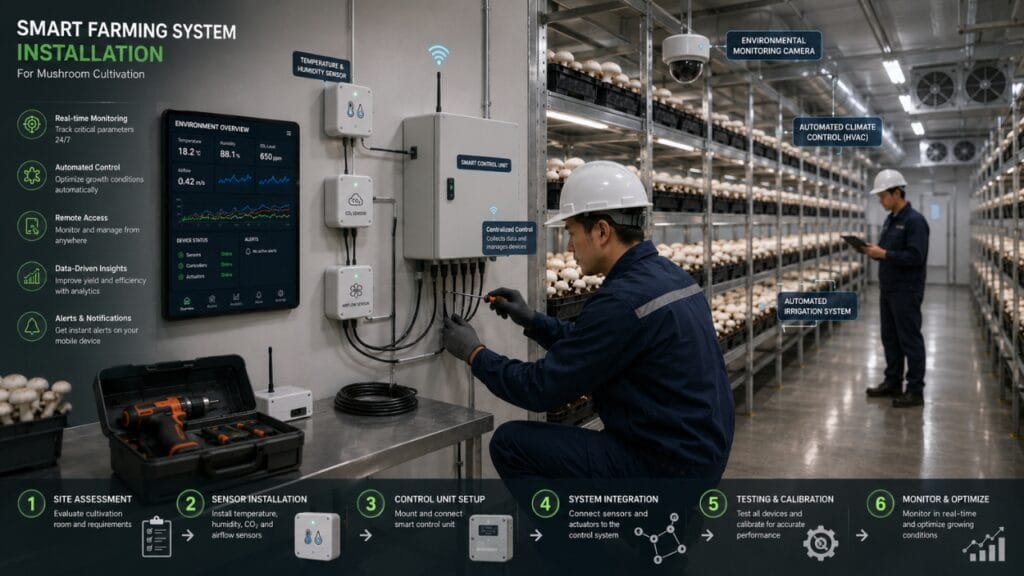
A typical IoT-based mushroom farming system includes:
- Environmental sensors
- Automated climate control equipment
- Internet-connected monitoring systems
- Data dashboards or mobile applications
These systems work together to create a more stable growing environment.
👉 The goal is precision and consistency
What Conditions Are Monitored?
IoT systems commonly track:
- Temperature → Critical for mushroom growth stages
- Humidity → Maintains proper moisture levels
- CO₂ Levels → Influences mushroom development
- Airflow and Ventilation → Helps maintain healthy growing conditions
👉 Small environmental changes can significantly impact yield
Automation in Smart Mushroom Farming
Once data is collected, IoT systems can automatically respond.
For example:
- Turn on humidifiers when humidity drops
- Adjust ventilation if CO₂ levels increase
- Activate cooling or heating systems automatically
👉 Reduces manual intervention
Remote Monitoring and Control
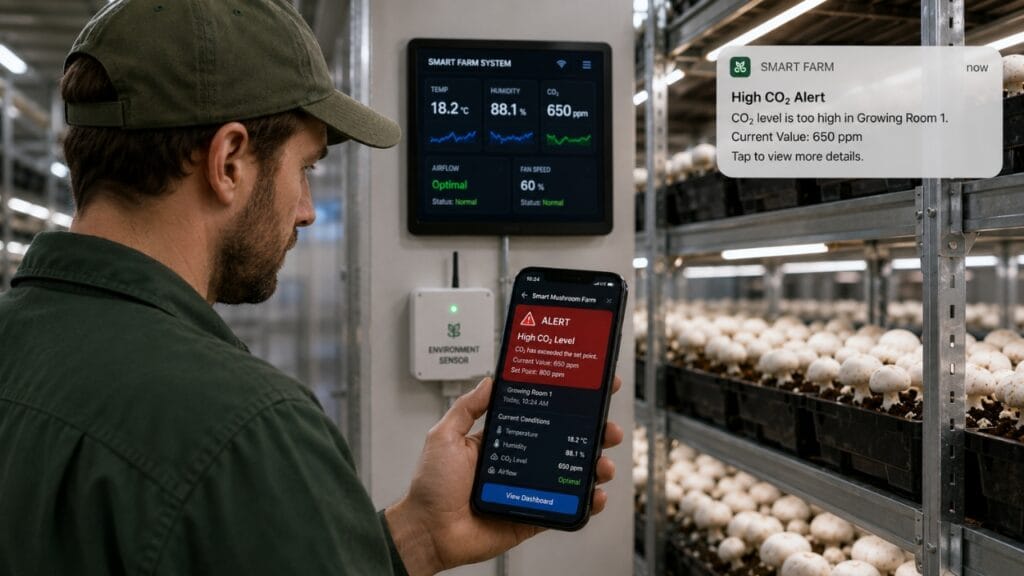
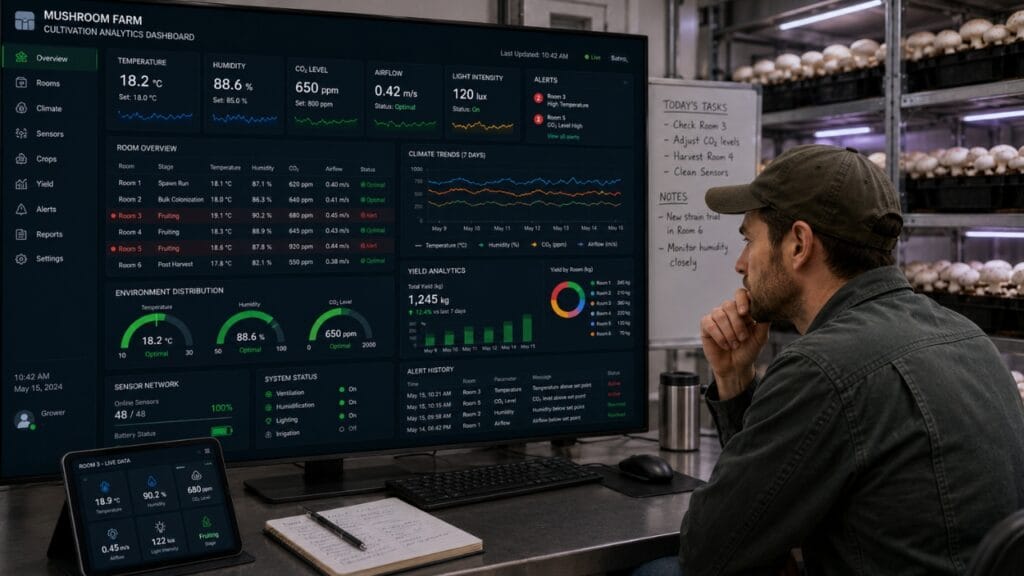
Many SmartFarm systems allow growers to monitor farms remotely using smartphones or dashboards.
This enables:
- Real-time alerts
- Faster decision-making
- Better operational control
👉 Farmers can manage conditions even when off-site
Key Takeaway
IoT in mushroom farming combines sensors, automation, and real-time monitoring to create a more controlled and efficient cultivation system.
👉 It transforms mushroom farming from reactive management to data-driven precision
Why Mushroom Farming Requires Precision
Mushroom cultivation is very different from traditional field farming. Mushrooms do not grow under open environmental conditions and are highly sensitive to changes in their surroundings. Because of this, maintaining precise growing conditions is essential for consistent production and quality.
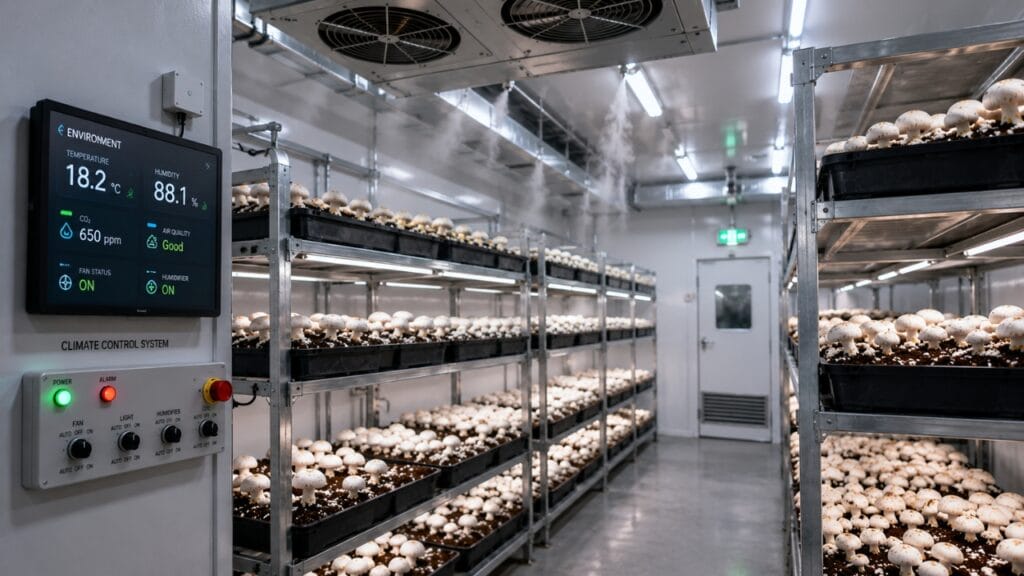
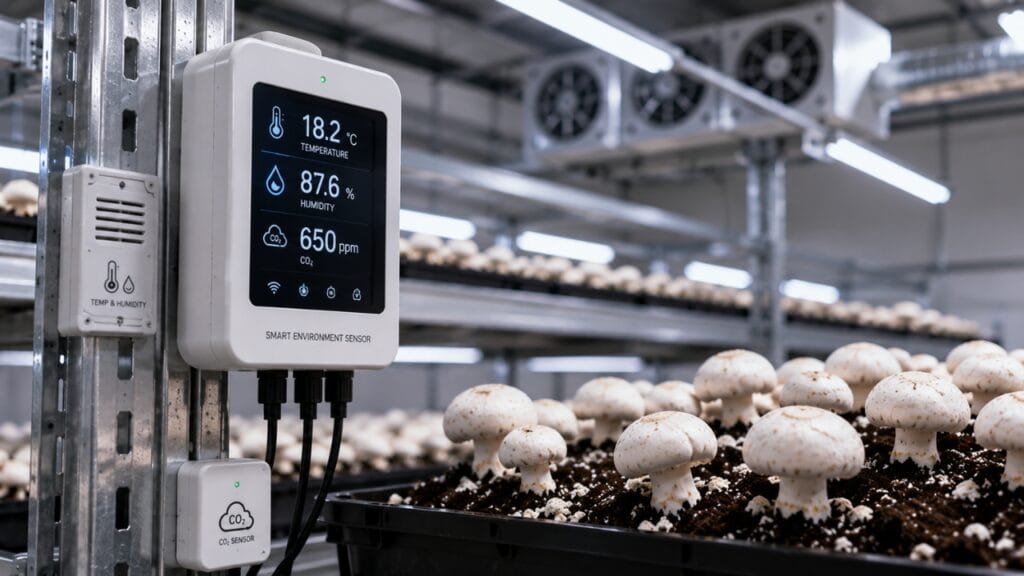
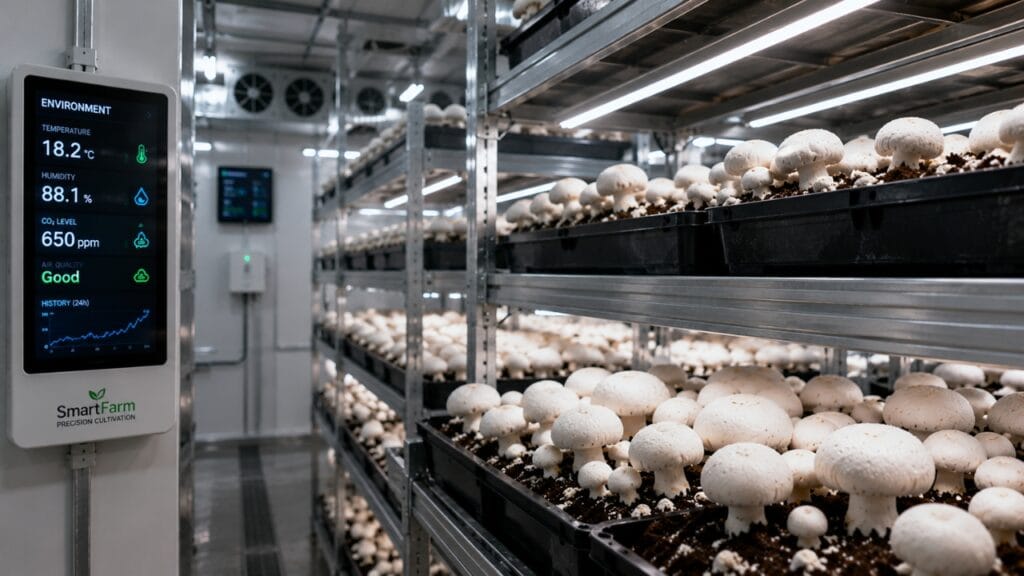
Even small fluctuations in climate can directly affect mushroom growth, yield, texture, and contamination risk.
Temperature Control is Critical
Different mushroom species require specific temperature ranges during various growth stages.
For example:
- Spawn running may require warmer conditions
- Fruiting stages often need cooler temperatures
If temperatures become unstable:
- Growth may slow down
- Yield quality can decrease
- Contamination risks may increase
Environmental stability also depends heavily on contamination prevention in mushroom farming.
👉 Stable temperature = stable production
Humidity Directly Impacts Mushroom Development
Mushrooms contain a high amount of water and rely heavily on environmental moisture.
Low humidity can cause:
- Dry surfaces
- Cracking
- Smaller fruiting bodies
Excess humidity may lead to:
- Bacterial growth
- Increased contamination
- Poor airflow conditions
👉 Balance is more important than extremes
CO₂ Levels Affect Mushroom Shape and Growth
Carbon dioxide management is one of the most important factors in indoor mushroom farming.
Poor ventilation and high CO₂ levels can cause:
- Long stems
- Small caps
- Abnormal growth patterns
Proper fresh air exchange helps mushrooms develop correctly.
👉 Air quality directly influences morphology
Airflow and Ventilation Must Be Consistent
Air circulation helps:
- Regulate temperature
- Maintain humidity distribution
- Reduce contamination hotspots
Inconsistent airflow can create uneven growing conditions inside cultivation rooms.
👉 Uniform environments improve consistency
Manual Monitoring Has Limitations
Traditional mushroom farming often depends on manual checks and adjustments. While experienced growers can manage conditions effectively, manual systems have limitations:
- Delayed response to environmental changes
- Human error
- Inconsistent monitoring
- Labor-intensive management
This is one of the main reasons IoT and SmartFarm systems are becoming more valuable in modern mushroom cultivation.
👉 Precision farming reduces uncertainty
Key Takeaway
Mushroom farming requires a highly controlled environment because mushrooms respond quickly to environmental changes. Precision monitoring and climate management are essential for achieving consistent yields and quality.
👉 The more controlled the environment, the more predictable the cultivation
Core Technologies Used in Smart Mushroom Farming
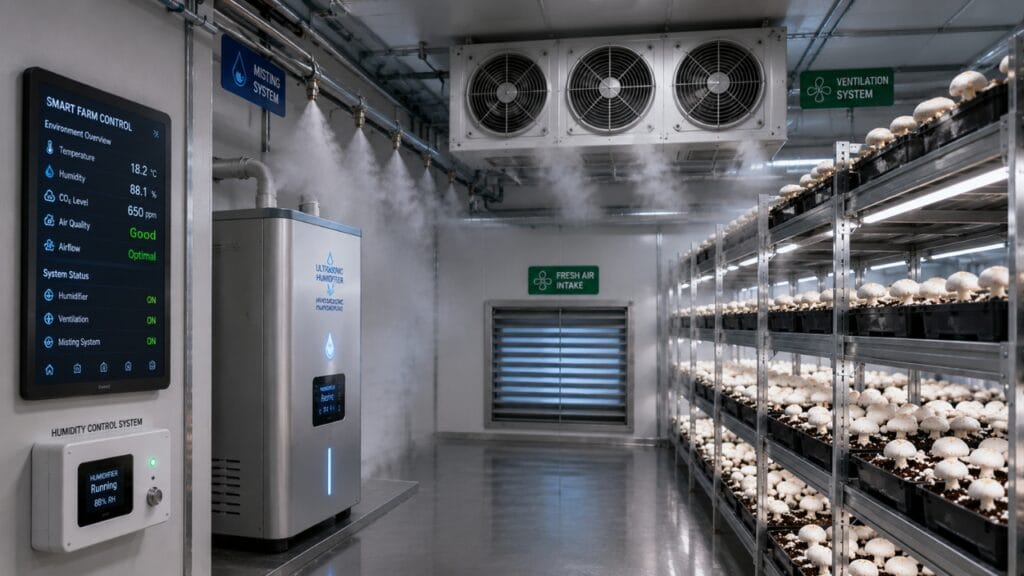
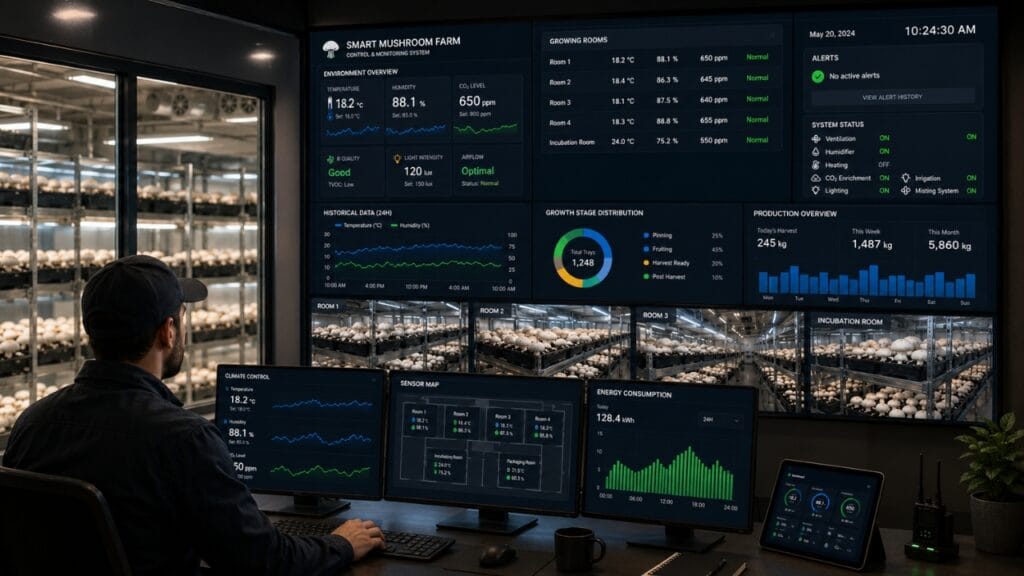
Smart mushroom farming relies on multiple technologies working together to create a controlled and data-driven cultivation environment. These technologies help growers monitor conditions more accurately, automate routine tasks, and improve overall farm efficiency.
Environmental Sensors
Environmental sensors are the foundation of IoT-based mushroom farming systems. These devices continuously collect real-time data from growing rooms.
Common sensors include:
- Temperature sensors
- Humidity sensors
- CO₂ sensors
- Airflow and pressure sensors
These sensors help growers detect environmental changes immediately instead of relying only on manual observation.
👉 Real-time monitoring improves precision
The effectiveness of smart systems improves further when paired with high-quality mushroom spawn quality management practices.
Automated Climate Control Systems
Once environmental data is collected, automated systems can adjust growing conditions automatically.
These systems may include:
- Smart humidifiers
- Ventilation systems
- Cooling and heating units
- Automated exhaust fans
For example:
- Humidity drops → humidifier activates
- CO₂ increases → ventilation adjusts automatically
This helps maintain stable cultivation conditions with minimal manual intervention.
👉 Automation supports consistency
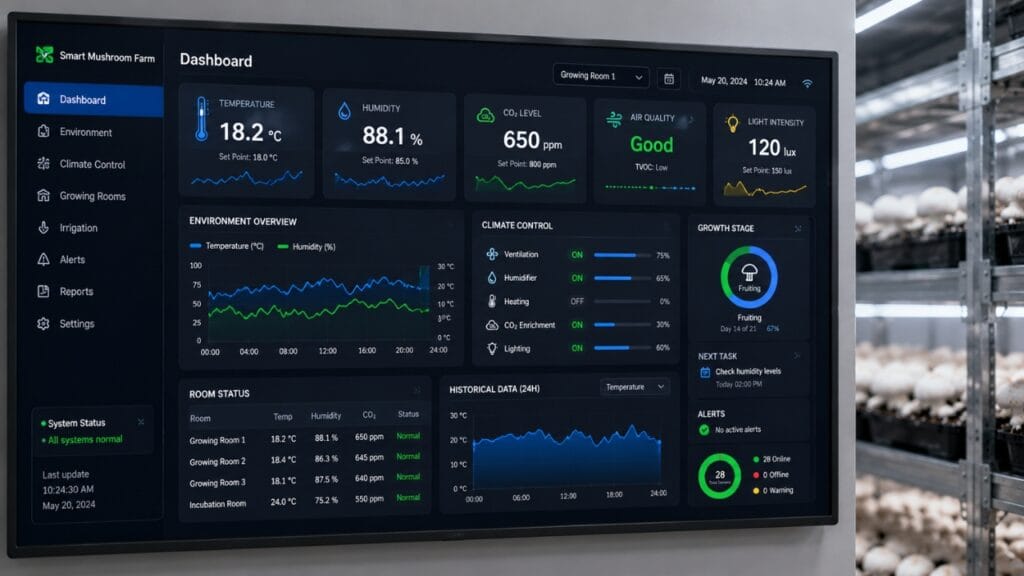
Remote Monitoring and Dashboard Systems
Modern SmartFarm systems often include centralized dashboards or mobile applications.
These platforms allow growers to:
- Monitor conditions remotely
- Receive alerts and notifications
- Track farm performance in real time
- Adjust settings from smartphones or computers
This is especially useful for large farms or multi-room cultivation setups.
👉 Farmers gain better operational visibility
Data Logging and Analytics
IoT systems continuously collect cultivation data over time.
This data can help growers:
- Identify environmental patterns
- Improve yield consistency
- Optimize growth cycles
- Detect recurring problems
Historical data becomes valuable for improving long-term decision-making.
👉 Data helps transform experience into measurable insights
Smart Alert and Notification Systems
One major advantage of IoT systems is instant alerts.
Growers can receive notifications when:
- Temperature exceeds limits
- Humidity becomes unstable
- Equipment fails
- CO₂ reaches unsafe levels
Fast alerts allow quicker corrective action, reducing crop risk.
👉 Early response prevents larger problems
Integration with Future Technologies
Advanced SmartFarm systems are beginning to integrate with:
- Artificial Intelligence (AI)
- Predictive analytics
- Cloud-based monitoring
- Automated scheduling systems
These technologies may further improve efficiency and reduce resource waste in the future.
👉 Smart farming continues to evolve rapidly
Key Takeaway
Smart mushroom farming combines sensors, automation, monitoring platforms, and data analysis to create more precise and efficient cultivation systems.
👉 Technology enables growers to make faster and better-informed decisions
Benefits of IoT in Mushroom Farming
The adoption of IoT and SmartFarm technologies is changing how mushroom farms operate. By combining automation, real-time monitoring, and data analysis, growers can improve both cultivation efficiency and production consistency.
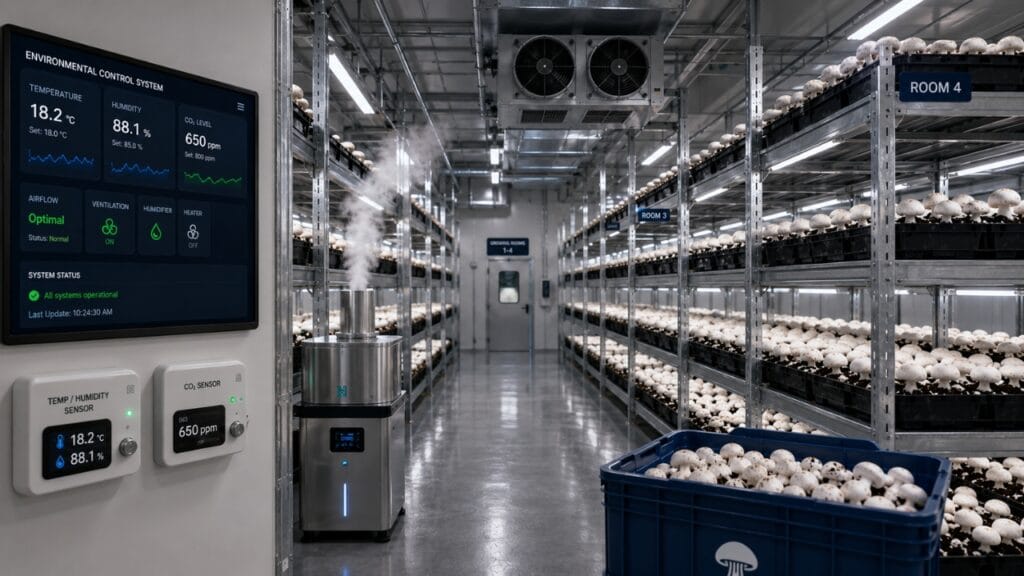
While traditional farming methods still play an important role, IoT systems help reduce many of the challenges associated with manual environmental management.
Improved Yield Consistency
One of the biggest advantages of IoT systems is the ability to maintain stable growing conditions.
Consistent control of:
- Temperature
- Humidity
- CO₂ levels
- Airflow
helps mushrooms develop more uniformly.
This can lead to:
- More predictable harvests
- Better mushroom quality
- Reduced environmental fluctuations
👉 Consistency is critical in commercial cultivation
You can also explore how technology supports oyster mushroom cultivation in controlled growing environments.
Reduced Human Error
Manual monitoring depends heavily on constant observation and timely adjustments.
IoT systems reduce risks caused by:
- Missed environmental changes
- Delayed responses
- Inconsistent monitoring routines
Automated systems can respond immediately when conditions move outside target ranges.
👉 Automation improves operational reliability
Better Resource Efficiency
Smart farming systems help optimize the use of farm resources.
Examples include:
- Running humidifiers only when needed
- Efficient ventilation control
- Optimized energy consumption
- Reduced water waste
This can improve operational efficiency while lowering unnecessary resource usage.
👉 Precision reduces waste
Lower Contamination Risk
Contamination is one of the biggest challenges in mushroom cultivation.
IoT systems help by:
- Maintaining stable environmental conditions
- Improving airflow management
- Detecting abnormal changes quickly
Early detection and faster corrective action may reduce contamination-related crop losses.
👉 Controlled environments improve biosecurity
Labor Optimization
Traditional mushroom farming often requires frequent manual checks throughout the day.
SmartFarm systems can automate many routine tasks such as:
- Environmental monitoring
- Climate adjustments
- Alert notifications
This allows growers to focus more on production management and quality control.
👉 Technology supports more efficient workflows
Real-Time Decision Making
Continuous data collection gives growers better visibility into farm operations.
With real-time information, growers can:
- Detect problems earlier
- Adjust cultivation strategies faster
- Improve long-term planning
Instead of reacting after problems occur, farms can become more proactive.
👉 Data-driven decisions improve management quality
Key Takeaway
IoT in mushroom farming improves precision, efficiency, and consistency by combining automation with real-time environmental monitoring.
👉 Smart farming helps growers reduce uncertainty and improve operational control
Real-World SmartFarm Applications
IoT and SmartFarm technologies are no longer limited to experimental agriculture. Many mushroom farms are already using smart systems to improve cultivation efficiency, reduce environmental fluctuations, and scale production more effectively.
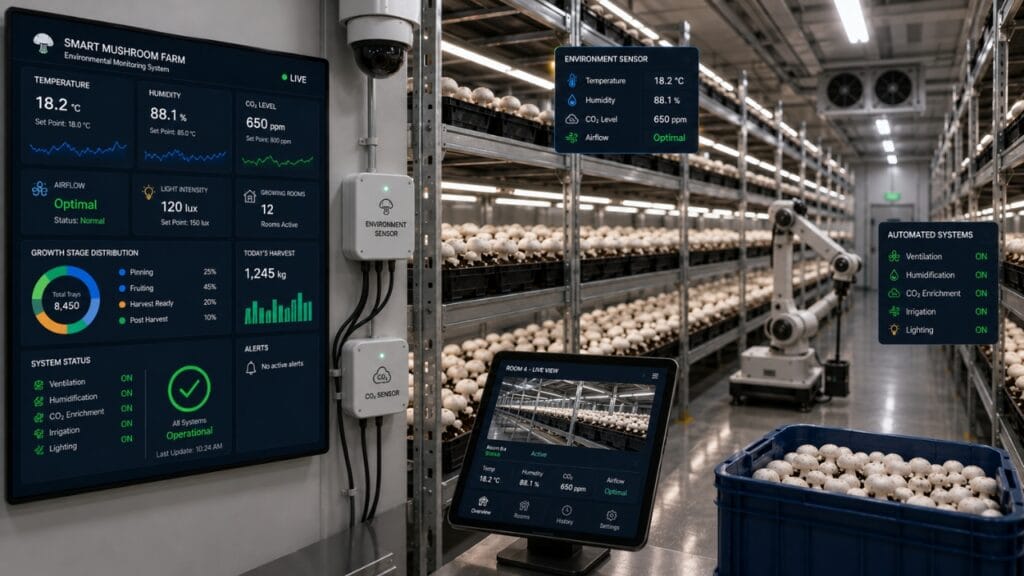
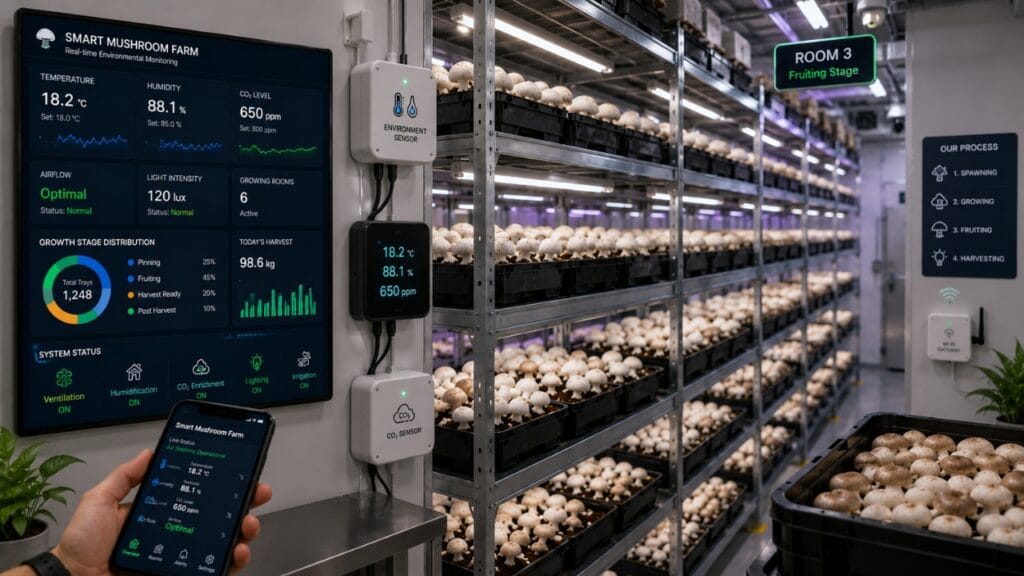
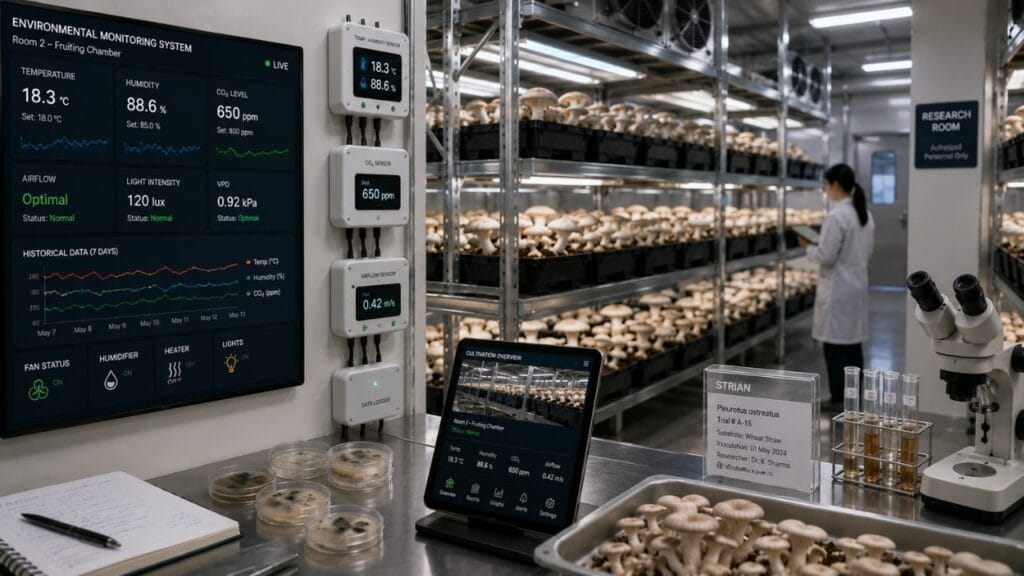
From small indoor farms to large commercial operations, smart farming is becoming increasingly practical and accessible.
Commercial Mushroom Farms
Large-scale mushroom farms often manage multiple growing rooms simultaneously. Maintaining stable conditions across all rooms manually can be difficult and labor-intensive.
SmartFarm systems help commercial growers by:
- Monitoring multiple cultivation zones in real time
- Automating climate adjustments
- Reducing operational inconsistencies
- Improving production planning
This allows larger farms to maintain more standardized production.
👉 Automation supports scalability
Indoor Controlled Environment Farming
Indoor mushroom cultivation is one of the most suitable areas for IoT integration because mushrooms already require controlled environments.
Smart indoor farms often use:
- Automated humidification systems
- CO₂-controlled ventilation
- Temperature-regulated chambers
- Centralized monitoring dashboards
These systems help maintain stable growing conditions throughout the cultivation cycle.
👉 Controlled environments work well with smart technology
Urban Mushroom Farming
Urban farming operations are increasingly adopting compact SmartFarm systems.
In cities, growers often face:
- Limited space
- Higher operational costs
- Need for efficient resource use
IoT systems help urban mushroom farms maximize productivity in smaller environments through precision monitoring and automation.
👉 Smart systems improve space efficiency
Research and Experimental Cultivation
Research facilities and experimental farms also use IoT systems to study cultivation patterns and optimize production techniques.
Data collected from smart farms can help:
- Analyze growth conditions
- Compare cultivation methods
- Improve environmental strategies
- Test new mushroom varieties
This contributes to long-term innovation in mushroom cultivation.
👉 Data supports continuous improvement
Hybrid Farming Models
Not all farms use fully automated systems. Many growers adopt hybrid models that combine traditional cultivation experience with selective smart technologies.
Examples include:
- Manual cultivation with automated climate monitoring
- Sensor-based alerts without full automation
- Partial remote monitoring systems
This allows farms to gradually integrate technology without major infrastructure changes.
👉 Smart farming can be adopted step by step
Key Takeaway
SmartFarm technology is already being used in commercial, indoor, urban, and research-based mushroom cultivation systems. Adoption can range from simple monitoring tools to highly automated farming environments.
👉 IoT is becoming a practical tool, not just a future concept
Challenges of Implementing IoT in Mushroom Farming
Although IoT and SmartFarm technologies offer many advantages, implementing smart systems in mushroom farming also comes with practical challenges. Technology can improve efficiency, but successful adoption requires proper planning, investment, and management.
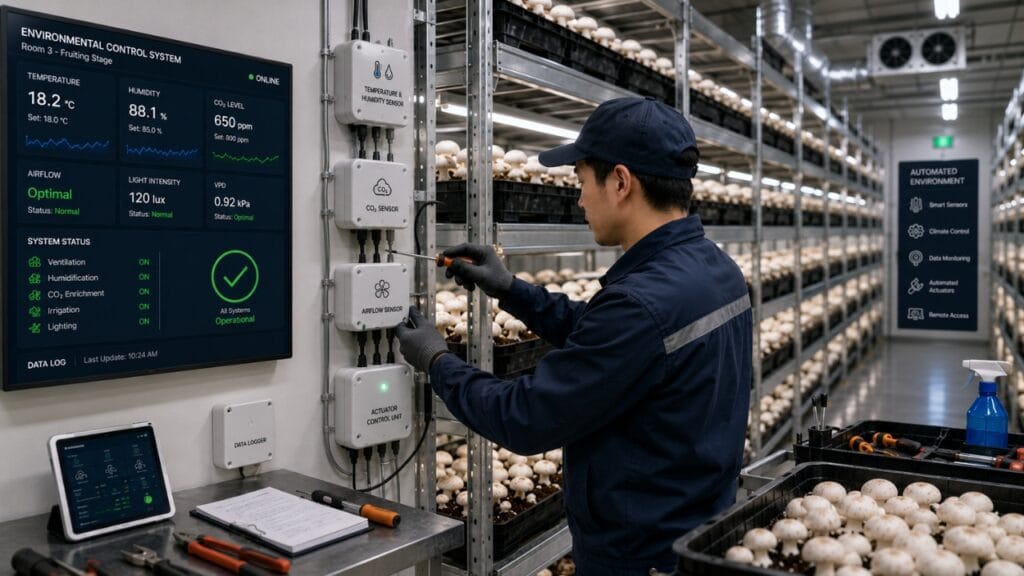
Understanding these limitations helps growers make more realistic and informed decisions.
Initial Setup Costs
One of the biggest barriers to adopting IoT systems is the upfront investment.
Smart farming infrastructure may require:
- Environmental sensors
- Automated climate equipment
- Monitoring software
- Internet-connected control systems
For small growers, the initial cost of setup can be difficult to justify immediately.
👉 Automation often requires long-term investment thinking
Technical Knowledge Requirements
Smart farming systems introduce a level of technical complexity that traditional farming may not require.
Growers may need to understand:
- Sensor calibration
- Data interpretation
- Software dashboards
- System troubleshooting
Without proper training, even advanced systems may not perform effectively.
👉 Technology is only useful when properly managed
Maintenance and Calibration
IoT systems require ongoing maintenance to remain accurate and reliable.
Over time:
- Sensors may drift from calibration
- Equipment can fail
- Monitoring systems may need updates
Regular inspection and maintenance are essential to prevent inaccurate readings or automation errors.
👉 Smart systems still require human oversight
Dependence on Internet and Electricity
Many SmartFarm systems rely heavily on stable internet connectivity and uninterrupted power supply.
Potential issues include:
- Internet outages
- Power failures
- System downtime
- Delayed monitoring alerts
In regions with unstable infrastructure, this can become a major operational challenge.
👉 Reliability of infrastructure matters
Data Overload and Misinterpretation
IoT systems generate large amounts of cultivation data.
While data is valuable, excessive information without proper analysis can create confusion rather than clarity.
Challenges may include:
- Over-monitoring
- Misreading environmental trends
- Making unnecessary adjustments
Successful smart farming depends on using data strategically, not simply collecting more of it.
👉 Better decisions matter more than more data
Not Every Farm Needs Full Automation
Some smaller farms may not require highly advanced systems.
In many cases:
- Basic environmental monitoring may be sufficient
- Partial automation may deliver better cost-efficiency
- Traditional expertise still remains highly valuable
Technology should support farming goals—not complicate them unnecessarily.
👉 Smart adoption is more important than full automation
Key Takeaway
While IoT in mushroom farming offers major advantages, successful implementation depends on balancing technology, cost, infrastructure, and operational needs.
👉 Smart farming works best when technology supports practical cultivation goals
Is Smart Mushroom Farming Suitable for Small Growers?
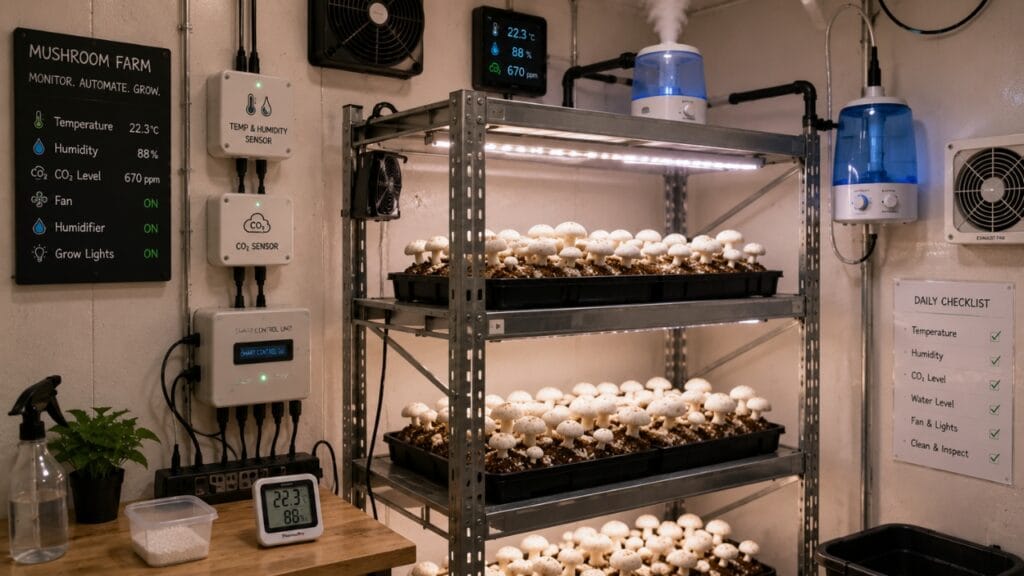
Smart mushroom farming is often associated with large commercial operations, but IoT technology is becoming increasingly accessible for small and medium-scale growers as well. Today, many smart farming tools are available in simpler and more affordable forms, making gradual adoption possible even for beginners.
The key is understanding that smart farming does not always mean building a fully automated facility from the beginning.
Small Farms Can Start with Basic Monitoring
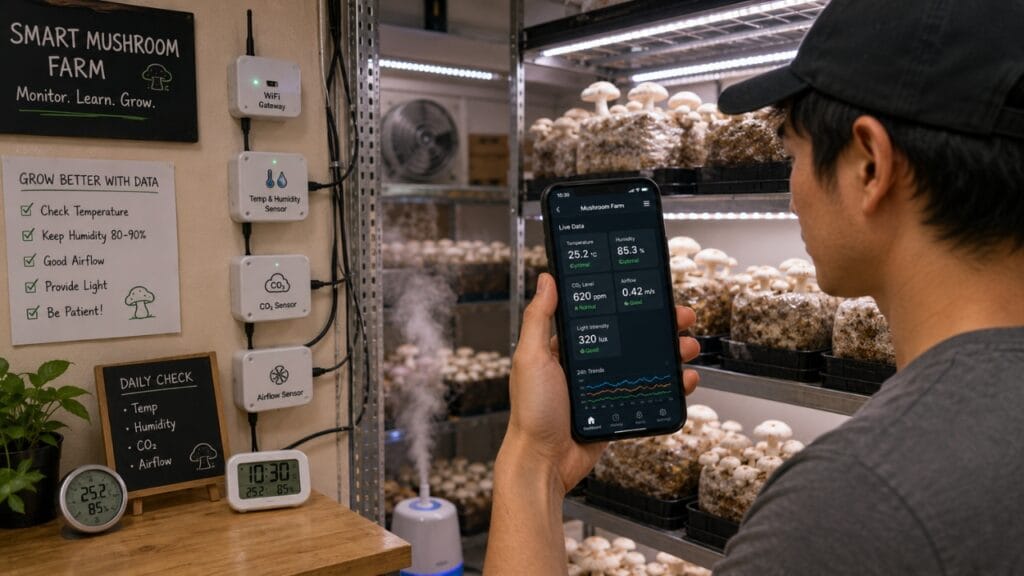
Many small growers begin with simple environmental monitoring systems rather than full automation.
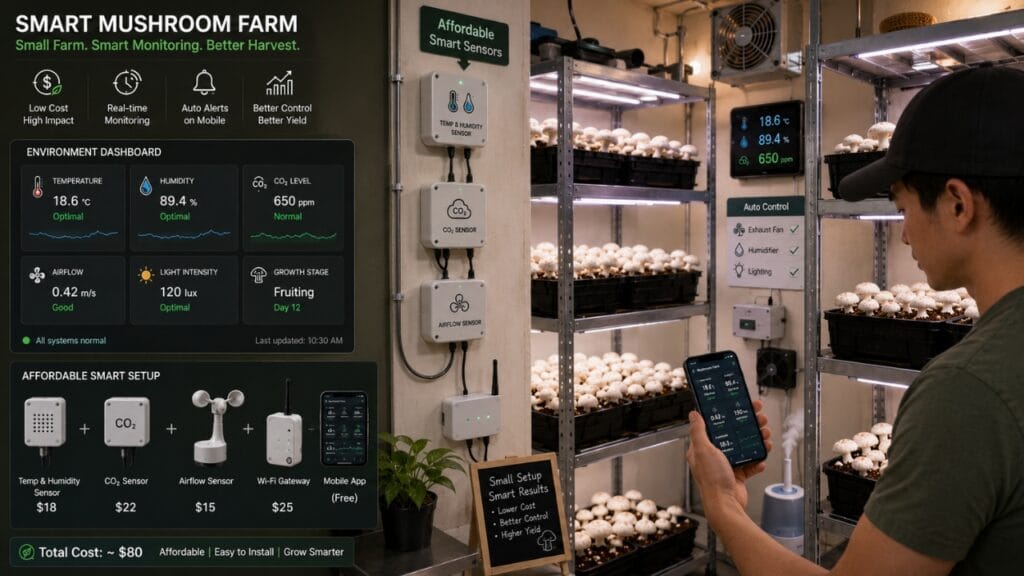
Basic setups may include:
- Temperature sensors
- Humidity monitoring devices
- CO₂ meters
- Mobile alert systems
These tools help growers gain better environmental visibility without large infrastructure investments.
👉 Even small improvements can increase cultivation consistency
Partial Automation Can Be Cost-Effective
Small farms do not always need complex smart systems.
Selective automation may already provide significant benefits, such as:
- Automated humidifiers
- Timer-based ventilation systems
- Smart exhaust fan controls
This allows growers to reduce manual workload while keeping operational costs manageable.
👉 Smart farming can scale gradually
IoT Helps Reduce Beginner Mistakes
New mushroom growers often struggle with environmental management.
Smart monitoring systems can help by:
- Providing real-time alerts
- Reducing delayed reactions
- Making environmental changes easier to detect
This can shorten the learning curve for beginners.
👉 Data helps improve decision-making confidence
Affordable Technology is Becoming More Available
As smart agriculture technology expands, lower-cost IoT devices are becoming more accessible.
Today, growers can find:
- Wi-Fi enabled sensors
- Smartphone-based monitoring apps
- Compact automation controllers
This makes smart cultivation more realistic for smaller operations than it was a few years ago.
👉 Technology barriers are gradually decreasing
For beginners, this guide on low-cost mushroom farming setup explains how to start efficiently.
Traditional Knowledge Still Matters
Even with automation, successful mushroom farming still depends on grower experience and cultivation knowledge.
IoT systems cannot replace:
- Proper substrate preparation
- Hygiene management
- Spawn quality
- Cultivation expertise
Technology works best when combined with strong farming practices.
👉 Smart systems support growers—they do not replace them
A Step-by-Step Adoption Approach Works Best
For many small growers, the most practical strategy is gradual implementation.
Example approach:
- Start with environmental monitoring
- Add basic automation
- Analyze cultivation data
- Expand systems as operations grow
This reduces financial risk while allowing growers to learn smart farming progressively.
👉 Incremental adoption is often more sustainable
Key Takeaway
Smart mushroom farming is no longer limited to large commercial facilities. Small growers can also benefit from IoT technology by starting with simple monitoring and gradually adopting automation based on their needs and budget.
👉 Smart farming is becoming more accessible, flexible, and scalable
The Future of IoT in Mushroom Cultivation
IoT technology is still evolving, and its role in mushroom farming is expected to expand significantly in the coming years. As smart agriculture becomes more advanced, mushroom cultivation is likely to become even more data-driven, automated, and resource-efficient.
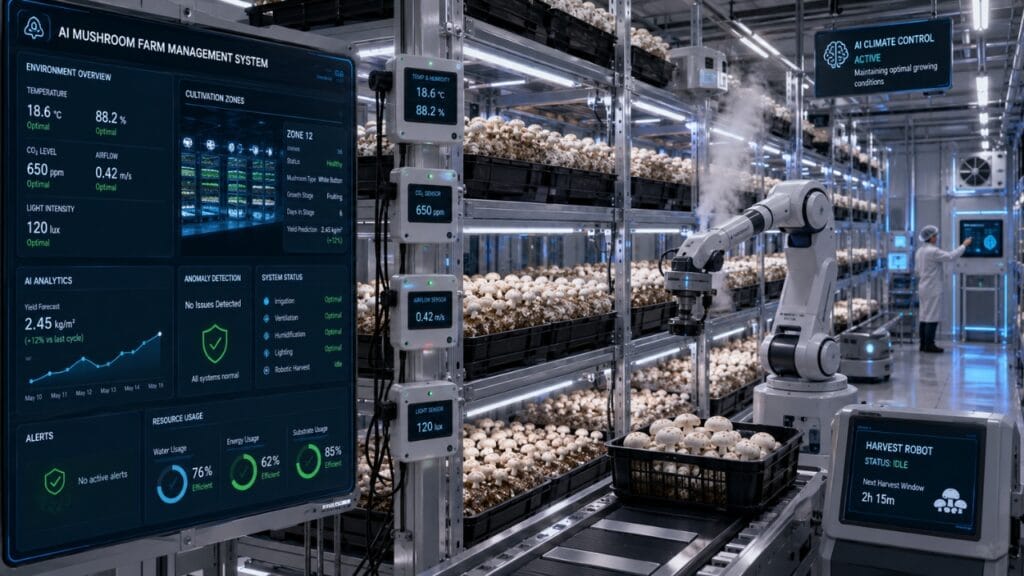
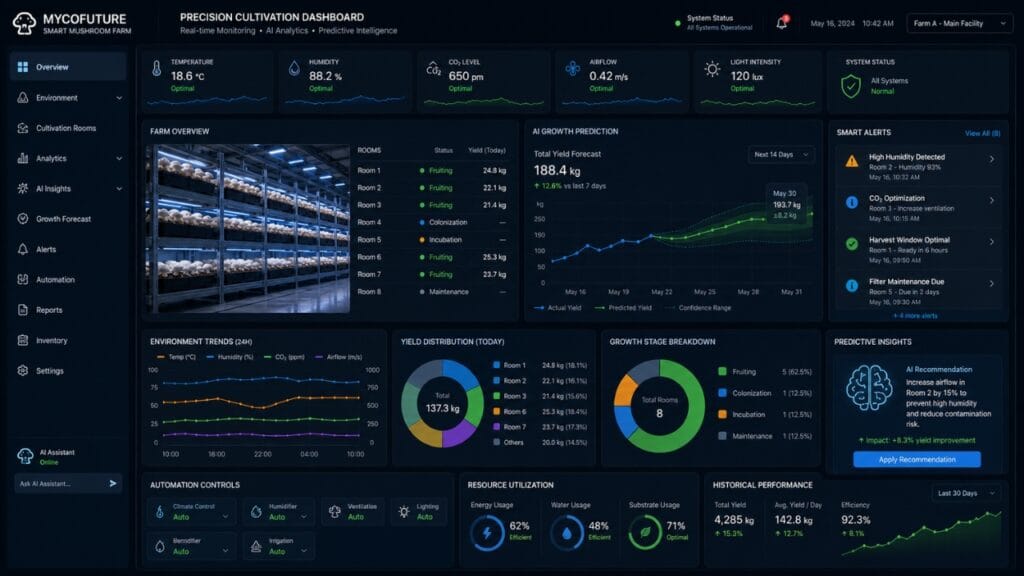
The future of SmartFarm systems will not only focus on automation, but also on improving decision-making, sustainability, and production predictability.
Smart agriculture technologies are increasingly shaping modern farming practices, as highlighted by the FAO Digital Agriculture initiative.
Artificial Intelligence and Predictive Farming
Future SmartFarm systems may combine IoT with Artificial Intelligence (AI) to improve cultivation accuracy.
AI-powered systems could help:
- Predict environmental fluctuations
- Detect contamination risks early
- Recommend climate adjustments automatically
- Analyze yield performance patterns
Instead of reacting to problems after they occur, farms may increasingly use predictive systems to prevent issues before they happen.
👉 Farming may become more proactive than reactive
Advanced Environmental Optimization
Future IoT systems are expected to provide even more precise environmental control.
Possible advancements include:
- Automated microclimate adjustments
- Adaptive humidity regulation
- Real-time airflow balancing
- Dynamic CO₂ optimization
This could improve:
- Yield uniformity
- Growth efficiency
- Resource management
👉 Precision levels may continue to increase
Integration with Cloud-Based Monitoring
Cloud-connected farming systems are making remote farm management more scalable.
Future systems may allow growers to:
- Monitor multiple farms from one platform
- Store long-term cultivation data
- Compare historical performance
- Access real-time analytics from anywhere
Cloud integration may become especially valuable for commercial operations managing multiple cultivation facilities.
👉 Centralized management improves scalability
More Affordable Smart Farming Solutions
As technology adoption increases, IoT devices are gradually becoming more accessible and cost-effective.
Future developments may lead to:
- Lower-cost sensors
- Simplified automation systems
- Easier installation and maintenance
- Wider adoption among small growers
This could help make smart mushroom farming more practical for a broader range of farmers.
👉 Accessibility may drive faster adoption
Sustainability and Resource Efficiency
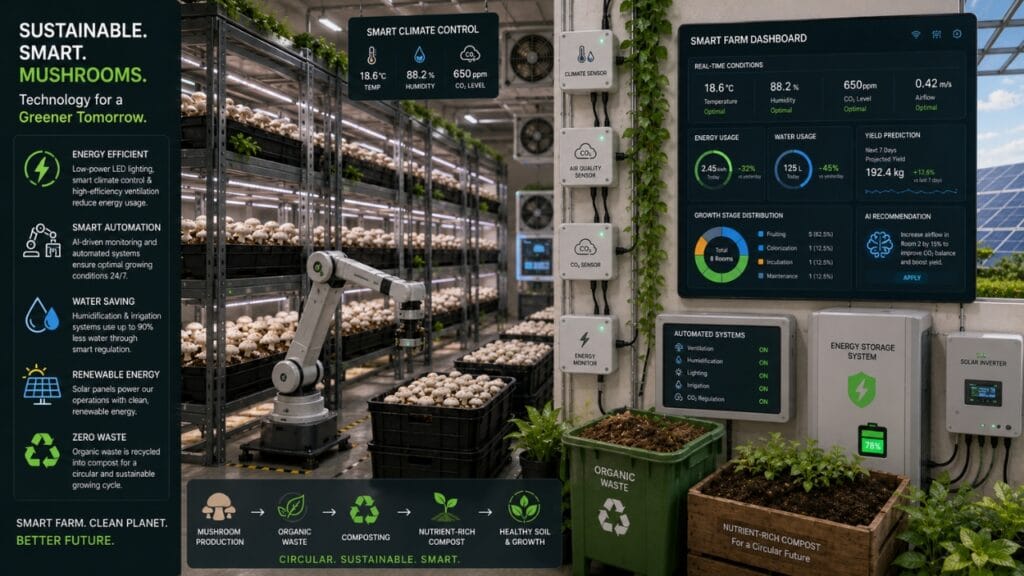
Sustainability is becoming increasingly important in agriculture, including mushroom cultivation.
Smart systems may help farms:
- Reduce energy waste
- Optimize water usage
- Improve environmental efficiency
- Reduce unnecessary operational inputs
This aligns smart farming with broader goals of sustainable agriculture and resource management.
👉 Efficiency and sustainability are becoming closely connected
Technology-driven farming is also influencing the future of medicinal mushroom cultivation and wellness products.
Human Expertise Will Still Remain Important
Even as automation improves, successful mushroom cultivation will still depend on grower knowledge and experience.
Technology can assist with:
- Monitoring
- Automation
- Data analysis
But growers will still play a critical role in:
- Cultivation strategy
- Biological understanding
- Farm management decisions
👉 Smart farming will enhance human expertise—not replace it
Key Takeaway
The future of IoT in mushroom cultivation is moving toward smarter, more connected, and more efficient farming systems. As technology becomes more accessible, smart farming may become a standard part of modern mushroom cultivation.
👉 The future of mushroom farming is likely to be increasingly data-driven and precision-focused.
Conclusion
IoT and SmartFarm technologies are gradually transforming mushroom farming from a highly manual process into a more precise and data-driven cultivation system. By combining environmental sensors, automation, and real-time monitoring, growers can improve consistency, reduce operational challenges, and make more informed farming decisions.
At the same time, smart farming is not simply about adding technology everywhere. Successful implementation depends on understanding the specific needs of each farm, balancing automation with practical cultivation knowledge, and adopting systems that genuinely improve efficiency.
As IoT technology becomes more affordable and accessible, smart mushroom farming is likely to expand across both commercial and small-scale operations. However, even the most advanced systems will still rely on grower expertise, biological understanding, and good cultivation practices.
The future of mushroom farming is not just automated—it is increasingly precise, connected, and knowledge-driven.
👉 Smart technology may change how mushrooms are cultivated, but skilled growers will remain at the center of successful farming.
Explore more cultivation insights and innovations through the Fruvini blog.
FAQs on IoT in Mushroom Farming
What is IoT in mushroom farming?
IoT in mushroom farming refers to the use of connected sensors, automation systems, and monitoring tools to manage cultivation conditions in real time.
How does IoT help mushroom cultivation?
IoT helps growers monitor factors like temperature, humidity, CO₂ levels, and airflow more accurately, improving consistency and reducing manual intervention.
What sensors are used in smart mushroom farming?
Common sensors include:
- Temperature sensors
- Humidity sensors
- CO₂ sensors
- Airflow and ventilation monitoring systems
These devices help maintain stable growing conditions.
Can IoT improve mushroom yield?
Yes, maintaining stable environmental conditions through IoT systems can help improve yield consistency, mushroom quality, and operational efficiency.
Is smart mushroom farming fully automated?
Not always. Some farms use full automation, while others use partial systems such as monitoring sensors or automated humidifiers alongside manual farming practices.
Is IoT in mushroom farming expensive?
The cost depends on the level of automation. Basic monitoring systems can be relatively affordable, while advanced commercial SmartFarm setups require higher investment.
Can small mushroom farms use SmartFarm technology?
Yes, small growers can start with basic environmental monitoring and gradually add automation as their operations expand.
Does IoT reduce contamination risk in mushroom farming?
IoT systems can help reduce contamination risk by maintaining more stable environmental conditions and detecting abnormal changes early.
Can mushroom farms be monitored remotely?
Yes, many IoT systems allow growers to monitor cultivation conditions remotely through smartphones, dashboards, or cloud-based platforms.
Will technology replace mushroom growers in the future?
No. Technology can support monitoring and automation, but successful mushroom farming still depends heavily on grower experience, cultivation knowledge, and management decisions.

Leave a Reply