
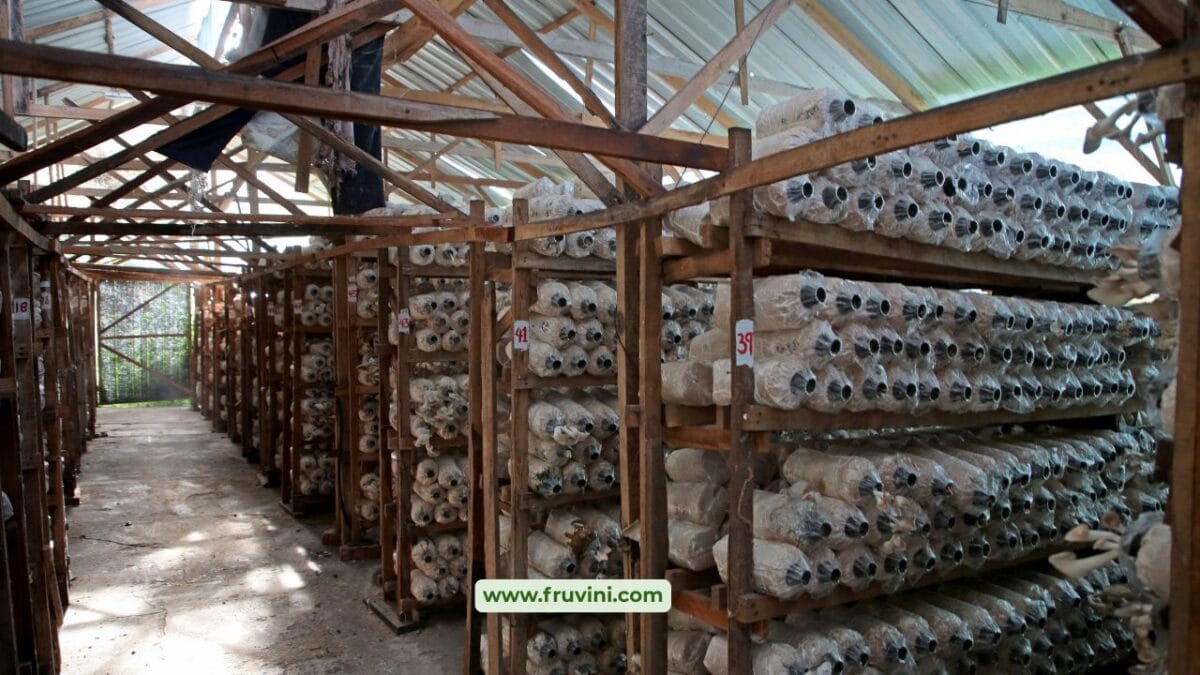
Mushroom farming cost & profit in India is one of the most searched topics today—and for a good reason. With rising demand for healthy food and increasing interest in low-investment businesses, mushroom farming has emerged as a practical and profitable opportunity for beginners, farmers, and entrepreneurs alike.
The biggest advantage? You don’t need large land or heavy capital to get started. Whether you begin from a small room at home or scale into a commercial setup, mushroom farming offers flexible investment options with the potential for steady income. In many cases, you can start earning within just 3–4 weeks of your first setup.
But here’s the reality—profitability in mushroom farming is not just about starting, it’s about understanding the numbers. Your success depends on how well you manage costs, choose the right mushroom, and maintain consistent production cycles.
In this complete guide, you’ll get a clear breakdown of mushroom farming cost & profit in India, including setup investment, per-cycle expenses, realistic income examples, and expert tips to maximize your returns—so you can start smart and grow profitably.
What Affects Mushroom Farming Cost and Profit in India?
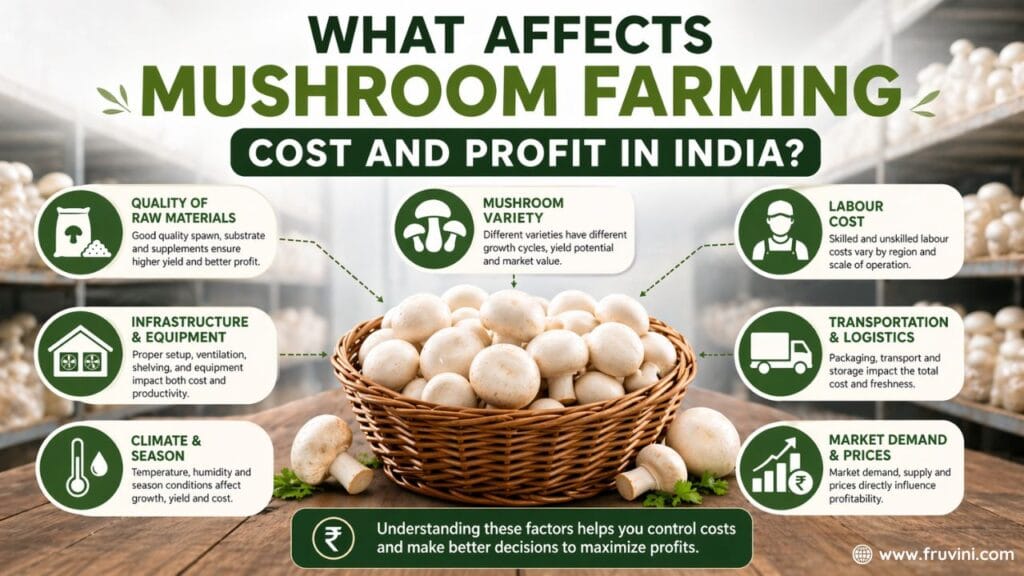
Before calculating mushroom farming cost & profit in India, it’s important to understand the key factors that influence your investment and returns. Many beginners focus only on profit, but real success comes from managing both cost and efficiency.
Here are the main factors that directly impact your profitability:
1. Type of Mushroom You Choose
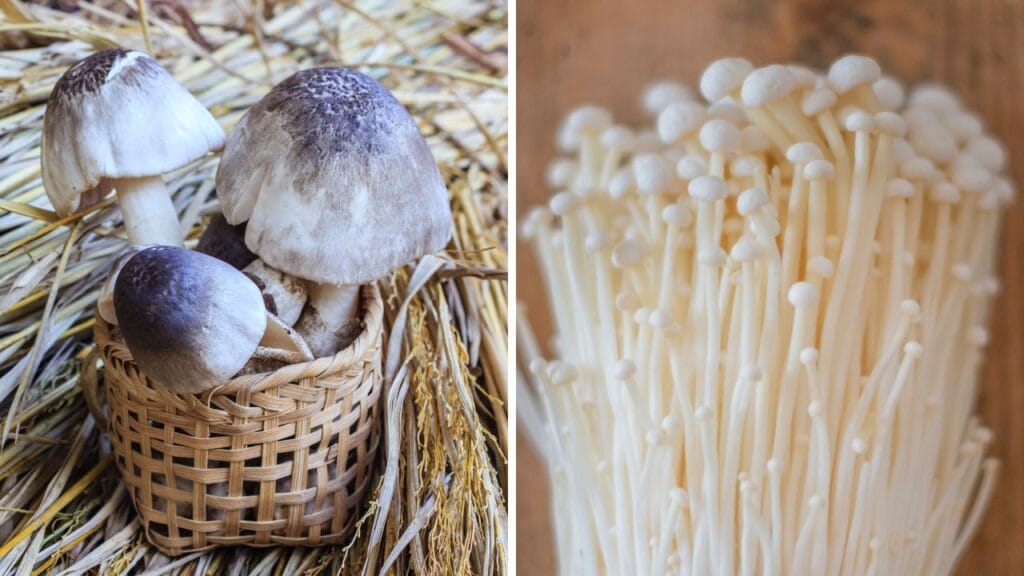
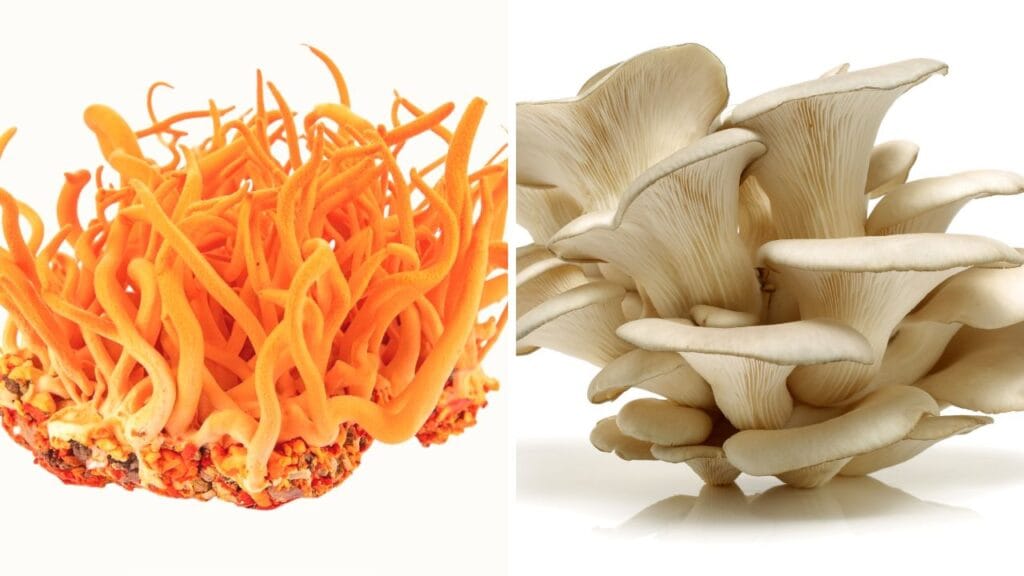
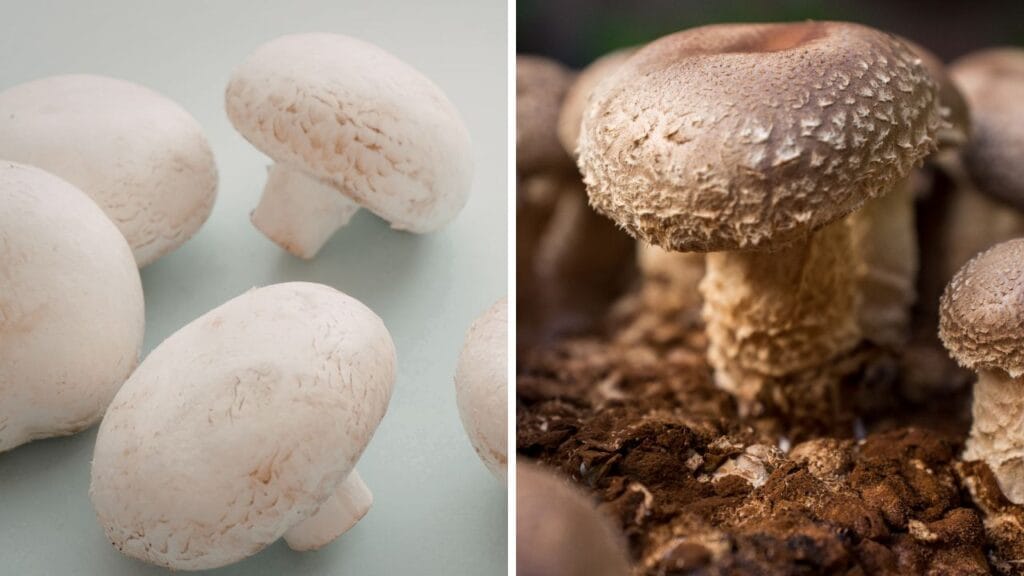
Different mushrooms require different levels of investment and care.
- Oyster → Low cost, beginner-friendly
- Button → Medium investment, high demand
- Shiitake → High investment, premium pricing
👉 Your choice directly affects both cost and profit potential
2. Scale of Farming (Small vs Commercial)
Your budget and goals determine the scale you start with.
- Small-scale → Low investment, lower risk
- Medium-scale → Better returns, moderate cost
- Commercial → High investment, high production
👉 Start small, scale once you understand the process
3. Location and Climate Conditions
Your local environment plays a major role in cost.
- Favorable climate reduces setup expenses
- Extreme temperatures require control systems
- Indoor setups increase cost but improve consistency
4. Infrastructure and Equipment
The type of setup you choose affects both cost and efficiency.
- Basic setup → low cost, manual work
- Advanced setup → higher cost, better control
- Automation increases consistency but requires investment
5. Labor and Daily Maintenance
Mushroom farming requires regular attention.
- Small setups can be managed alone
- Larger farms may require labor
- Daily monitoring impacts yield and profit
Key Takeaway
The actual mushroom farming cost & profit in India depends on how well you balance these factors. Lower cost doesn’t always mean higher profit—efficiency, consistency, and smart decisions make the real difference.
Initial Investment for Mushroom Farming in India
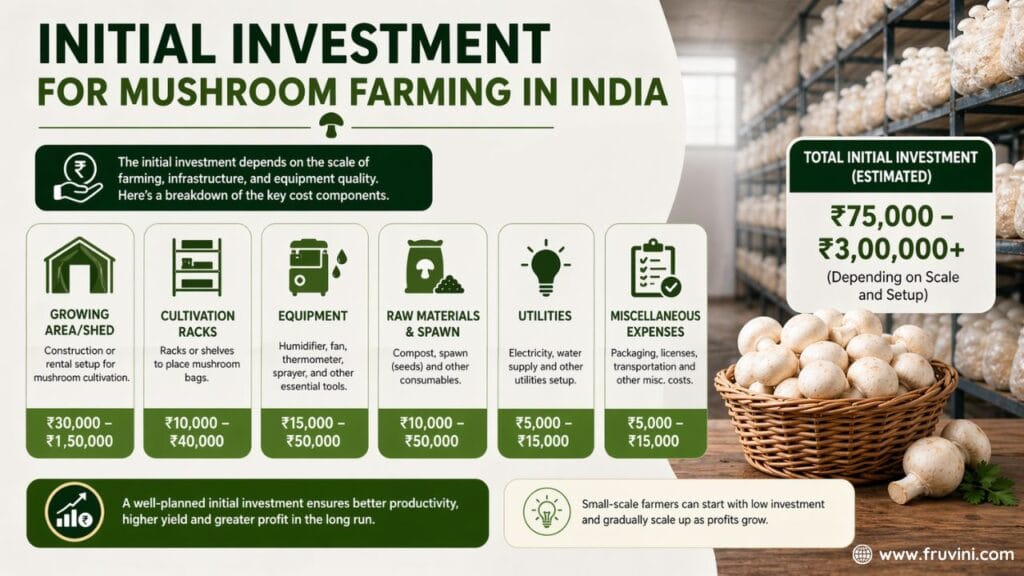
Understanding the initial investment is essential when evaluating mushroom farming cost & profit in India. The good part is—you can start small and scale gradually based on your experience and budget.
Let’s break it down by different levels:
Small-Scale Setup (Home-Based Farming)
This is ideal for beginners who want to learn and start with low risk.
Estimated Cost: ₹1,500 – ₹5,000
Includes:
- Mushroom spawn
- Straw/substrate
- Plastic growing bags
- Spray bottle
- Basic setup (room or small space)
👉 Best option for testing mushroom farming at home.
Medium-Scale Setup (Semi-Commercial Farming)
Suitable for those looking to earn regular income.
Estimated Cost: ₹20,000 – ₹1,00,000
Includes:
- Larger quantity of spawn and substrate
- Racks or shelves for vertical farming
- Basic temperature and humidity control
- Improved space management
👉 Higher production = better income potential
Commercial Mushroom Farming Setup
For serious entrepreneurs aiming for large-scale production.
Estimated Cost: ₹2 lakh and above
Includes:
- Climate-controlled rooms
- Advanced equipment (humidifiers, ventilation systems)
- Labor costs
- Continuous production setup
👉 High investment, but strong long-term profit potential
Key Insight
Your starting investment should match your experience level and risk capacity. Jumping into large-scale farming without understanding the basics often leads to losses.
👉 Start small → learn → scale smartly
Detailed Cost Breakdown (Per Cycle)
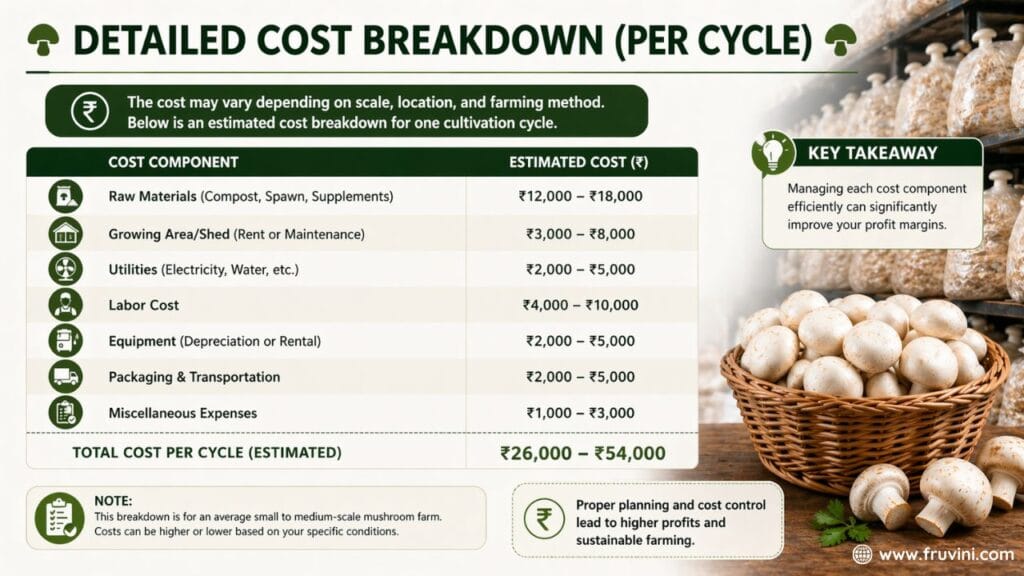
To truly understand mushroom farming cost & profit in India, you need to look at expenses per growing cycle. This gives a more accurate picture of your ongoing costs and actual profitability.
Here’s a typical breakdown (based on small to medium-scale farming):
1. Mushroom Spawn Cost
Spawn is the most important input in mushroom farming.
- Cost: ₹80 – ₹150 per kg
- Determines yield and success rate
👉 High-quality spawn = better production
2. Substrate Cost (Straw or Compost)
The substrate acts as food for mushrooms.
- Cost: ₹20 – ₹50 per kg
- Includes straw, husk, or compost preparation
👉 Using local materials can reduce cost significantly
3. Labor Cost (If Applicable)
Labor depends on the scale of your operation.
- Small scale → usually self-managed (₹0)
- Medium/large scale → ₹5,000+ per month
👉 Efficient workflow reduces labor cost
4. Electricity and Water
Environmental control requires basic utilities.
- Electricity: ₹500 – ₹2,000/month
- Water: minimal but essential for humidity
👉 Costs increase with climate control systems
5. Packaging and Transportation
Selling your product involves additional costs.
- Packaging materials: ₹2 – ₹10 per unit
- Transport: depends on distance and scale
👉 Direct selling can reduce these costs
Estimated Total Cost Per Cycle (Small Setup)
- Total cost: ₹1,000 – ₹3,000 (approx.)
- Depends on scale and efficiency
Key Insight
Profit doesn’t come from low cost alone—it comes from managing cost per cycle while maintaining good yield.
👉 The more cycles you complete efficiently, the higher your overall profit
Yield and Production Estimates
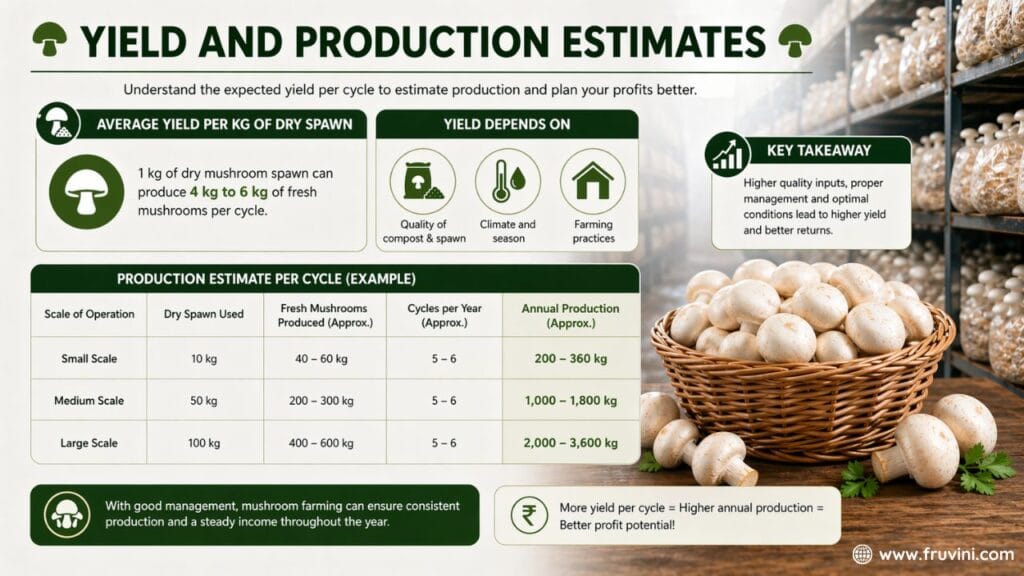
To understand mushroom farming cost & profit in India, you must know how much output you can expect from your setup. Yield directly determines your income, so having realistic expectations is crucial.
1. Yield per Kg of Spawn
The amount of mushrooms you get depends largely on the quality of spawn and growing conditions.
- 1 kg of spawn → 2 to 3 kg mushrooms (average)
- Good management can increase yield further
- Poor conditions can reduce output significantly
👉 Yield efficiency = key to higher profit
2. Number of Harvest Cycles (Flushes)
Mushrooms don’t grow just once—you can harvest multiple times from the same setup.
- Typically 2–3 flushes per cycle
- First flush gives highest yield
- Later flushes produce slightly less
👉 Proper care increases total production per cycle
3. Time Required Per Cycle
Time affects how many cycles you can complete in a year.
- Oyster mushrooms: 20–30 days per cycle
- Paddy straw: 10–15 days (fastest)
- Button mushrooms: 30–40 days
👉 Faster cycles = more earning opportunities
4. Factors That Affect Yield
Several factors influence how much you produce:
- Quality of spawn
- Temperature and humidity control
- Cleanliness and contamination prevention
- Daily monitoring and care
👉 Small mistakes can reduce yield significantly
Simple Example (Small Setup)
- 5 kg spawn → 10–15 kg mushrooms
- Selling at ₹150/kg → ₹1,500 – ₹2,250 revenue per cycle
👉 Now you can clearly connect cost → yield → income
Key Takeaway
Higher yield doesn’t come from luck—it comes from consistency, quality inputs, and proper management. Improving your yield is the fastest way to increase profit without increasing cost.
Mushroom Farming Profit in India (Realistic Examples)
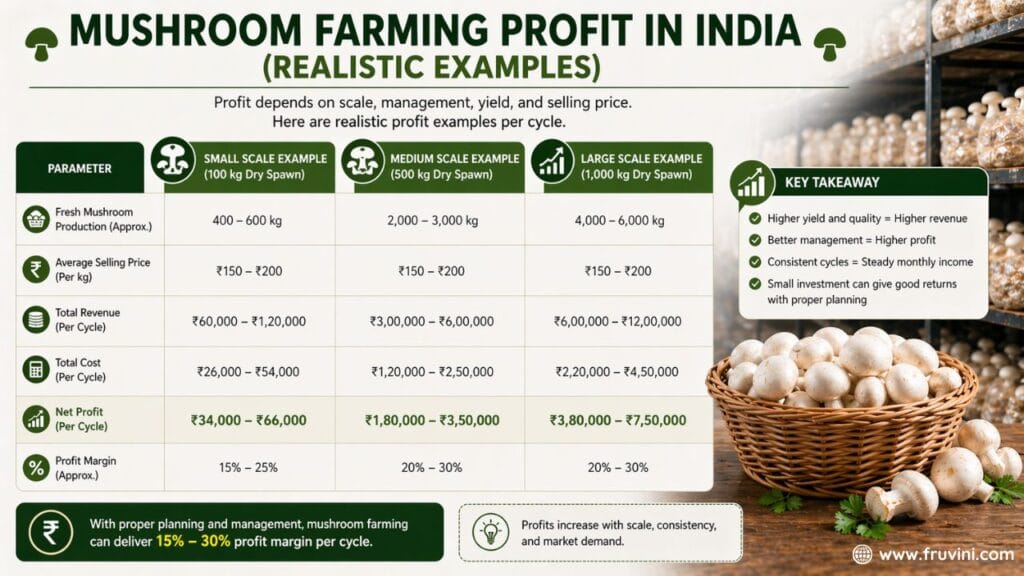
Understanding mushroom farming cost & profit in India becomes much clearer when you look at real examples. Instead of vague claims, let’s break it down based on different scales.
Example 1: Small-Scale Setup (Home-Based)
Investment: ₹2,000 – ₹5,000
Spawn Used: 5 kg
Expected Yield: 10–15 kg mushrooms
Selling Price: ₹120 – ₹200/kg
Revenue: ₹1,200 – ₹3,000 per cycle
Profit: ₹500 – ₹1,500 per cycle (approx.)
👉 Ideal for learning + small side income
Example 2: Medium-Scale Setup (Semi-Commercial)
Investment: ₹30,000 – ₹80,000
Spawn Used: 30–50 kg
Expected Yield: 60–120 kg mushrooms
Selling Price: ₹120 – ₹250/kg
Revenue: ₹7,200 – ₹30,000 per cycle
Profit: ₹4,000 – ₹15,000 per cycle (approx.)
👉 Suitable for steady monthly income
Example 3: Commercial Setup (Large-Scale Farming)
Investment: ₹2 lakh+
Spawn Used: 100+ kg
Expected Yield: 200–400+ kg mushrooms
Selling Price: ₹120 – ₹300/kg
Revenue: ₹24,000 – ₹1,20,000+ per cycle
Profit: ₹10,000 – ₹50,000+ per cycle (approx.)
👉 High potential, but requires experience and management
Important Reality Check
Let’s be honest—these are average estimates, not guaranteed results.
- First 1–2 cycles are for learning
- Profit improves with experience
- Mistakes in environment or hygiene can reduce yield
👉 Consistency is what turns small profits into a stable income
Key Takeaway
The real power of mushroom farming lies in repeat cycles. Even small profits per cycle can turn into strong monthly income when you scale and maintain consistency.
Profit Margin in Mushroom Farming
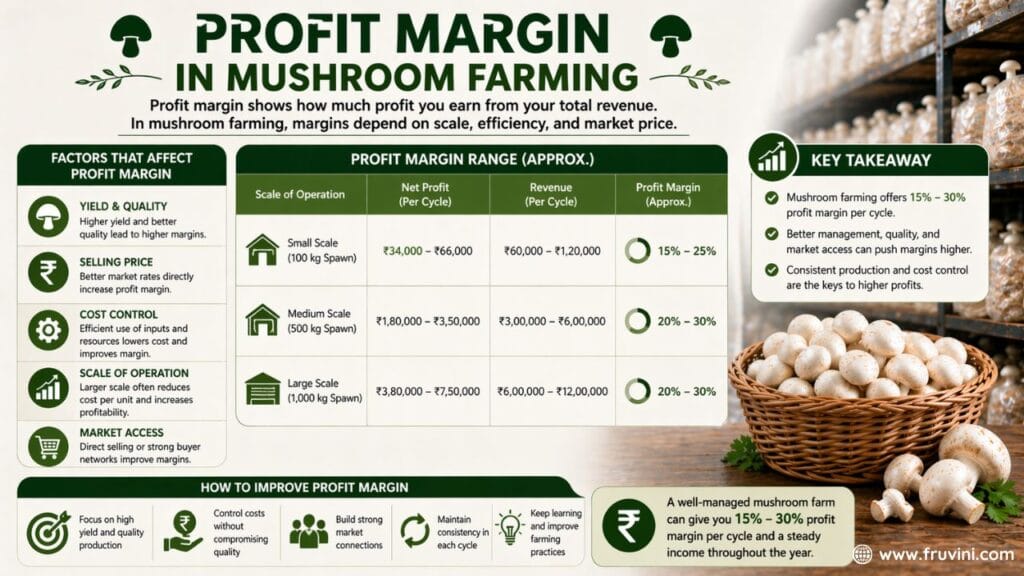
When analyzing mushroom farming cost & profit in India, understanding profit margin is essential. It tells you how much you actually earn after covering all expenses—not just your total sales.
What is Profit Margin in Mushroom Farming?
Profit margin is the percentage of income left after deducting all costs like spawn, substrate, labor, and utilities.
👉 Simple formula:
Profit Margin = (Profit ÷ Revenue) × 100
Average Profit Margin in India
In most cases, mushroom farming offers:
- 20% – 50% profit margin (depending on setup and efficiency)
- Higher margins in small-scale setups (lower overhead cost)
- Moderate margins in large-scale farms (higher operational cost)
High vs Low Profit Scenarios
✅ High Profit Margin (40–50%)
- Using high-quality spawn
- Maintaining ideal temperature & humidity
- Direct selling to customers (no middleman)
- Low waste and contamination
❌ Low Profit Margin (10–20%)
- Poor yield due to bad conditions
- High electricity or labor cost
- Selling at lower market prices
- Post-harvest losses
What Increases Your Profit Margin?
- Improving yield per cycle
- Reducing input costs (local materials)
- Selling directly to customers or restaurants
- Creating value-added products (dried mushrooms, powder)
👉 Smart selling = higher profit than just growing
Key Takeaway
Profit in mushroom farming is not fixed—it depends on how efficiently you manage your process. Even a small setup can deliver strong margins if done correctly.
👉 Focus on efficiency, not just scale
Most Profitable Mushrooms in India (Quick Insight)
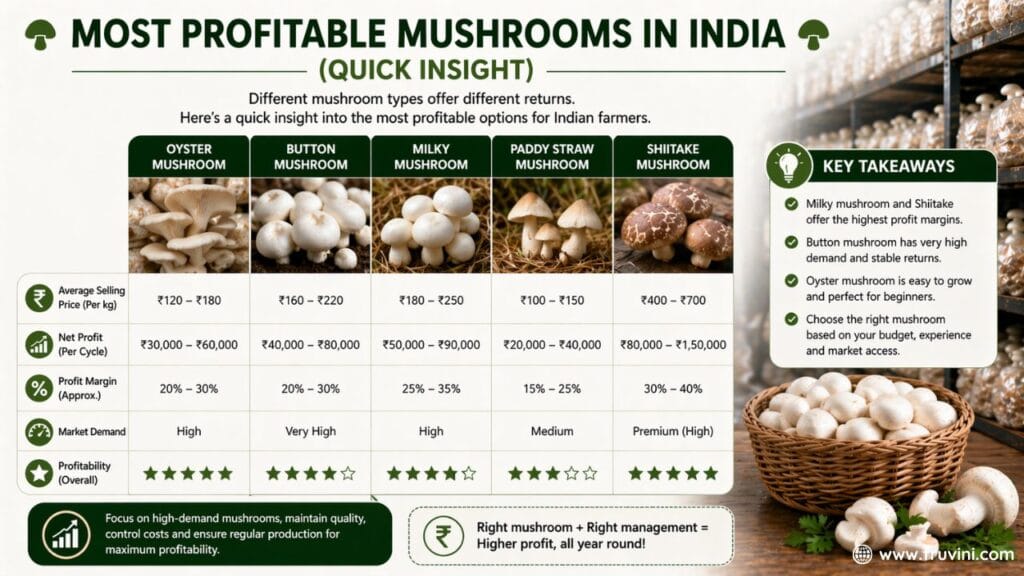
When evaluating mushroom farming cost & profit in India, choosing the right mushroom variety plays a major role in your overall returns. Different mushrooms offer different levels of investment, difficulty, and profit potential.
Here’s a quick overview of the most profitable options:
1. Oyster Mushroom (Best for Beginners)
- Low investment and easy to grow
- Fast harvest cycle (20–25 days)
- High demand in local markets
👉 Ideal for starting with low risk and steady income
2. Button Mushroom (High Demand Market)
- Most consumed mushroom in India
- Strong demand in hotels and retail
- Requires controlled conditions
👉 Suitable for semi-commercial and commercial setups
3. Milky Mushroom (Best for Warm Climate)
- Grows well in Indian climate
- Good shelf life and market price
- Moderate difficulty
👉 Great option for consistent production in warm regions
4. Shiitake Mushroom (Premium Profit)
- High-value mushroom with premium pricing
- Growing demand in urban markets
- Requires advanced setup
👉 High profit potential for experienced growers
Quick Comparison
| Mushroom Type | Investment | Difficulty | Profit Potential |
|---|---|---|---|
| Oyster | Low | Easy | High |
| Button | Medium | Medium | High |
| Milky | Low-Med | Medium | High |
| Shiitake | High | Hard | Very High |
Key Takeaway
The best choice depends on your budget, experience, and local market. For beginners, oyster mushrooms offer the safest and most profitable start, while advanced growers can explore premium varieties for higher returns.
Common Mistakes That Reduce Profit
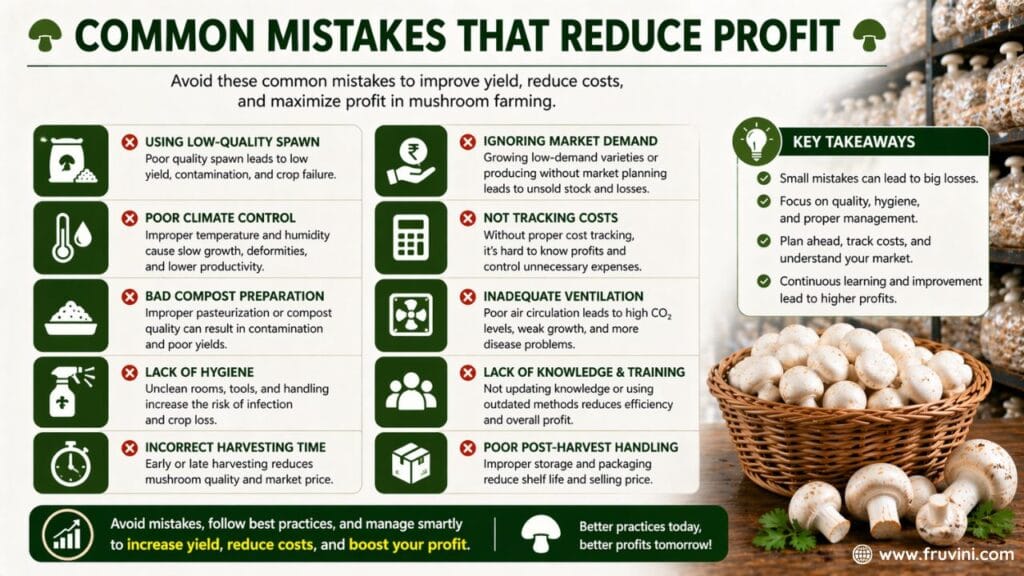
Even if you understand mushroom farming cost & profit in India, small mistakes can quickly reduce your earnings. Many beginners lose money not because the business is bad—but because they overlook key basics.
Here are the most common mistakes you should avoid:
1. Using Low-Quality Mushroom Spawn
Your entire crop depends on the quality of spawn.
- Poor spawn leads to low yield or contamination
- Can result in complete batch failure
- Always buy from a trusted source
👉 This is the biggest factor affecting profit
2. Poor Temperature and Humidity Control
Mushrooms are sensitive to environmental conditions.
- Too dry → poor growth
- Too humid → contamination risk
- Irregular conditions reduce yield
👉 Stability is more important than perfection
3. Ignoring Hygiene and Cleanliness
Contamination is one of the biggest profit killers.
- Dirty tools or environment introduce bacteria
- Can destroy multiple bags at once
- Always maintain a clean growing space
4. Over-Investing in the Beginning
Many beginners spend too much before learning the basics.
- High setup cost increases risk
- Lack of experience leads to mistakes
- Start small and scale gradually
👉 Learning phase should be low-cost
5. Weak Selling Strategy
Growing mushrooms is only half the job—selling is equally important.
- Delayed selling reduces freshness and value
- Lack of buyers affects profit
- Build local connections early
👉 Profit comes from selling, not just growing
Key Takeaway
Avoiding these mistakes can significantly improve your mushroom farming cost & profit in India. Success in this business is less about doing something extraordinary and more about doing the basics consistently right.
Tips to Increase Profit in Mushroom Farming
If you want to improve your mushroom farming cost & profit in India, the focus should not only be on reducing costs but also on maximizing yield and selling smartly. Small improvements can significantly boost your overall earnings.
1. Improve Yield Efficiency
Higher yield means more income from the same investment.
- Use high-quality spawn
- Maintain proper humidity and temperature
- Monitor growth daily
👉 Better yield = better profit without extra cost
2. Reduce Input Costs Smartly
Cutting unnecessary expenses improves your margin.
- Use locally available substrate (straw, husk)
- Avoid over-spending on equipment initially
- Reuse materials where possible
👉 Smart cost control increases net profit
3. Sell Directly to Customers
Eliminating middlemen boosts your earnings.
- Sell to local customers, restaurants, or shops
- Build repeat buyers
- Offer fresh and consistent supply
👉 Direct selling = higher profit margins
4. Explore Value-Added Products
Don’t limit yourself to fresh mushrooms.
- Dried mushrooms have longer shelf life
- Mushroom powder can be sold at higher prices
- Reduces losses from unsold stock
👉 Value addition = extra income stream
5. Maintain Consistency in Production
Consistency is the key to stable income.
- Plan regular production cycles
- Avoid gaps between batches
- Ensure continuous supply to customers
👉 Regular production = regular income
6. Start Small, Then Scale Smartly
- Focus on learning in early cycles
- Improve process before expanding
- Scale only when results are consistent
👉 Scaling without learning leads to losses
Key Takeaway
Increasing profit in mushroom farming is not about working harder—it’s about working smarter. Focus on yield, cost control, and smart selling, and your income will grow naturally.
Conclusion
Understanding mushroom farming cost & profit in India is the first step toward building a successful and sustainable farming business. As you’ve seen, the investment can be low, the returns can be steady, and the opportunity is real—but only if you approach it with the right strategy.
Whether you start with a small home setup or plan to scale into a commercial operation, the key is to focus on efficiency, consistency, and continuous learning. Your first few cycles may not bring maximum profit, but they will build the experience needed to grow confidently.
Mushroom farming is not just about growing—it’s about managing costs, improving yield, and selling smartly. If done correctly, even a small setup can turn into a reliable source of income over time.
👉 Start small, stay consistent, and scale smartly—that’s the real formula for profit.
FAQs on Mushroom Farming Cost & Profit in India
What is the cost of mushroom farming in India?
The cost can range from ₹1,500–₹5,000 for small-scale setups to ₹2 lakh+ for commercial farming, depending on size and infrastructure.
Is mushroom farming profitable in India?
Yes, mushroom farming can be profitable with proper management. Profit margins typically range between 20%–50% based on efficiency and scale.
How much can I earn from mushroom farming?
Earnings vary by scale. Small setups may generate a few thousand per cycle, while larger farms can earn ₹50,000+ per cycle.
Which mushroom is most profitable in India?
Oyster mushrooms are best for beginners, while shiitake offers higher profits for experienced growers.
Can I start mushroom farming with low investment?
Yes, you can start with as little as ₹1,500–₹5,000 using a basic home setup and gradually scale up.

Leave a Reply