
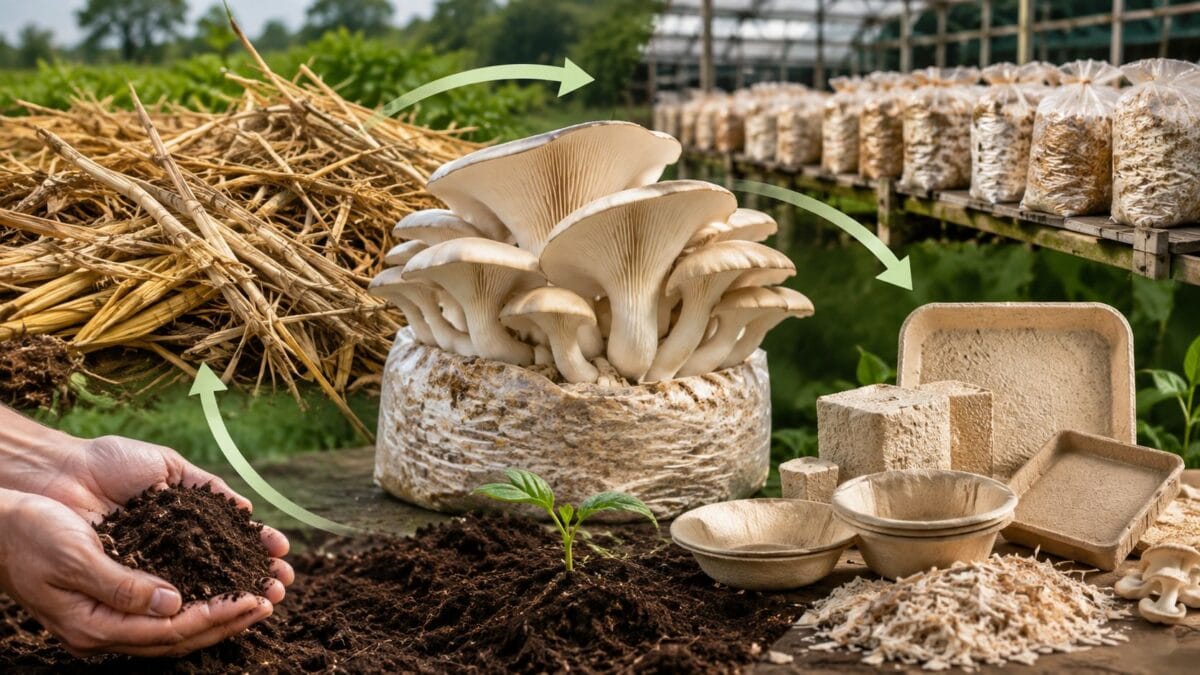
Introduction: Rethinking Waste Through Mushrooms
Every year, millions of tonnes of agricultural residues such as straw, husks, stalks, and other crop by-products are generated around the world. While some of this biomass is reused, a significant portion is still burned, discarded, or left to decompose, contributing to environmental pollution and the loss of potentially valuable resources.
As industries, governments, and communities look for more sustainable ways to manage resources, the concept of the circular economy has gained increasing attention. Unlike the traditional “take, make, and dispose” model, a circular economy focuses on keeping resources in productive use for longer by reducing waste, reusing materials, and creating new value from what was previously considered waste.
This is where mushrooms offer a remarkable opportunity.
Mushrooms are natural decomposers that can grow on many types of agricultural residues, converting low-value biomass into nutritious food. Their contribution does not necessarily end at harvest. The remaining cultivation substrate can potentially be repurposed for applications such as compost, soil amendments, vermicompost, bioenergy feedstock, and—in suitable systems—other value-added uses.
Mycelium, the vegetative network of fungi, is also being explored as a biological material for packaging, composites, insulation, and other sustainable products.
This ability to create multiple forms of value from biological resources makes mushroom cultivation an excellent example of a mushroom-based circular economy.
In this article, we explore how mushrooms can convert agricultural residues into food, how mushroom cultivation by-products can be utilized, the emerging potential of mycelium-based materials, and what a circular mushroom economy could mean for sustainable agriculture and the bioeconomy.
What Is a Mushroom-Based Circular Economy?
A mushroom-based circular economy is a system in which biological resources and by-products associated with mushroom cultivation are kept in productive use for as long as practical.
Instead of treating crop residues as waste, suitable agricultural biomass can become a raw material for mushroom cultivation. After mushrooms are harvested, the remaining substrate may enter another productive cycle rather than being immediately discarded.
Understanding the Circular Economy
A circular economy seeks to reduce waste and extract greater value from resources throughout their lifecycle.
In agriculture, this can mean reducing unnecessary inputs, reusing biological resources, recovering useful materials, and returning organic matter or nutrients to productive systems.
The objective is not simply to manage waste better. It is to design systems in which waste generation itself is reduced because one process’s by-product can become another process’s input. The UN Environment Programme’s work on circular food systems and circular business models provides broader context for how circular approaches can reshape food-system value chains.
Linear Economy vs Circular Economy
A simplified linear agricultural pathway might look like:
Crop Production → Agricultural Residue → Disposal or Burning
A mushroom-based circular pathway can instead look like:
Agricultural Residue → Mushroom Substrate → Mushroom Production → Spent Mushroom Substrate → Compost / Soil Amendment / Vermicompost / Other Suitable Uses
Additional fungal technologies can create separate pathways in which plant residues and mycelium are engineered into biomaterials.
The important principle is simple: materials remain productive for longer instead of becoming waste after a single use.
Why Mushrooms Are Effective Biological Recyclers
Fungi play an important ecological role in decomposing organic matter.
Many cultivated mushrooms can utilize lignocellulosic materials containing compounds such as cellulose, hemicellulose, and lignin.
Depending on the mushroom species and cultivation system, suitable substrates can include materials such as:
- Paddy straw
- Wheat straw
- Sawdust
- Sugarcane bagasse
- Maize residues
- Cotton waste
- Coffee-processing residues
- Other suitable lignocellulosic biomass
Through fungal growth, part of this biomass is converted into mushroom biomass while the substrate itself undergoes biological transformation.
Creating Multiple Value Streams
A circular mushroom system can potentially generate value through several stages:
- Fresh mushrooms
- Dried and processed mushroom products
- Mushroom powders and food ingredients
- Spent Mushroom Substrate (SMS)
- Compost and soil amendments
- Vermicompost
- Biomass or bioenergy applications
- Specialized mycelium-derived materials
Not every output is appropriate for every cultivation system, but the principle remains powerful: the same biological resource can potentially support more than one productive cycle.
How Mushrooms Convert Agricultural Waste into Food
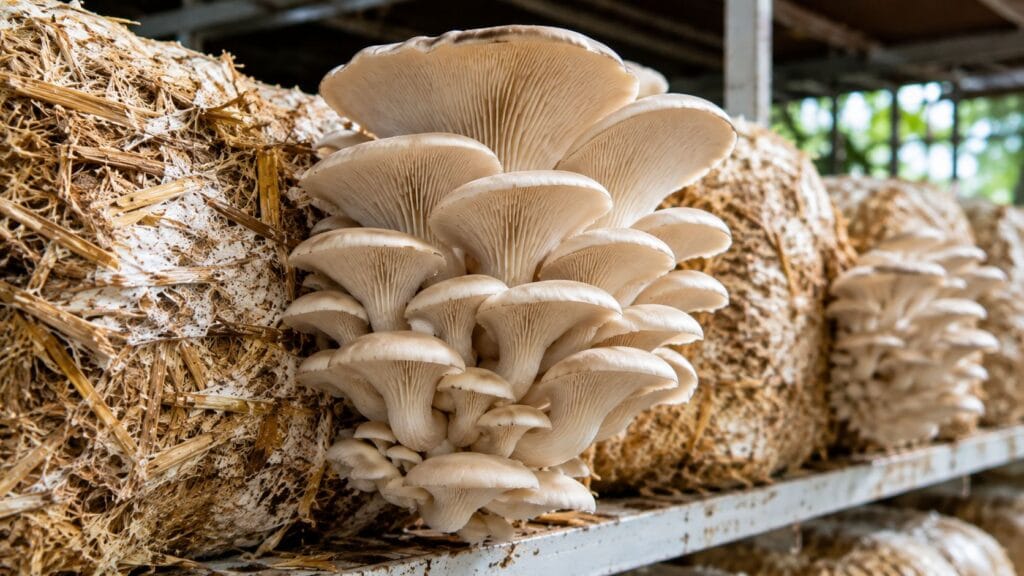
One of the strongest examples of circularity in mushroom cultivation is the conversion of agricultural residues into edible food.
Unlike conventional crops that depend primarily on soil-based nutrient uptake and photosynthesis, cultivated fungi obtain nutrients by decomposing suitable organic materials.
Agricultural Residues Become a Resource
Farms and food-processing systems generate substantial quantities of biomass after harvest and processing.
Depending on species, location, substrate preparation, and food-safety requirements, mushroom cultivation can utilize materials such as:
- Paddy straw
- Wheat straw
- Maize residues
- Sugarcane bagasse
- Sawdust
- Cotton waste
- Coffee-processing residues
- Other plant-based biomass
Instead of treating these materials only as disposal challenges, mushroom cultivation can turn selected residues into productive inputs.
The Biological Conversion Process
Mushrooms grow through a network of fungal filaments called mycelium.
When suitable mushroom spawn is introduced into a properly prepared substrate, the mycelium colonizes it and secretes enzymes that help break down complex plant materials.
The fungus utilizes available nutrients for growth and, under appropriate environmental conditions, eventually produces fruiting bodies—the mushrooms that are harvested as food.
This biological conversion is what makes mushroom farming particularly interesting from a circular-economy perspective.
High-Value Food from Low-Value Biomass
Agricultural residues that may have relatively low economic value can become the foundation for a higher-value food crop.
The resulting mushrooms can then enter several markets as:
- Fresh produce
- Dried mushrooms
- Mushroom powders
- Seasonings
- Ready-to-cook foods
- Other processed products
For readers interested in value-added formats, see our guide to the health benefits of mushroom powder.
Circularity therefore creates an opportunity not only to reduce waste but also to increase the economic productivity of existing agricultural biomass.
Efficient Use of Existing Resources
Mushroom cultivation does not eliminate the environmental footprint associated with farming. Substrate preparation, climate control, transport, water, and energy still matter. For a deeper look at managing these variables, see our guide to controlled environment mushroom farming.
However, using suitable agricultural by-products as cultivation inputs can extend the productive life of resources that have already been generated by another agricultural process.
This is one of the central principles of circular agriculture: create more useful output from resources already within the system.
Valuable By-products of Mushroom Farming
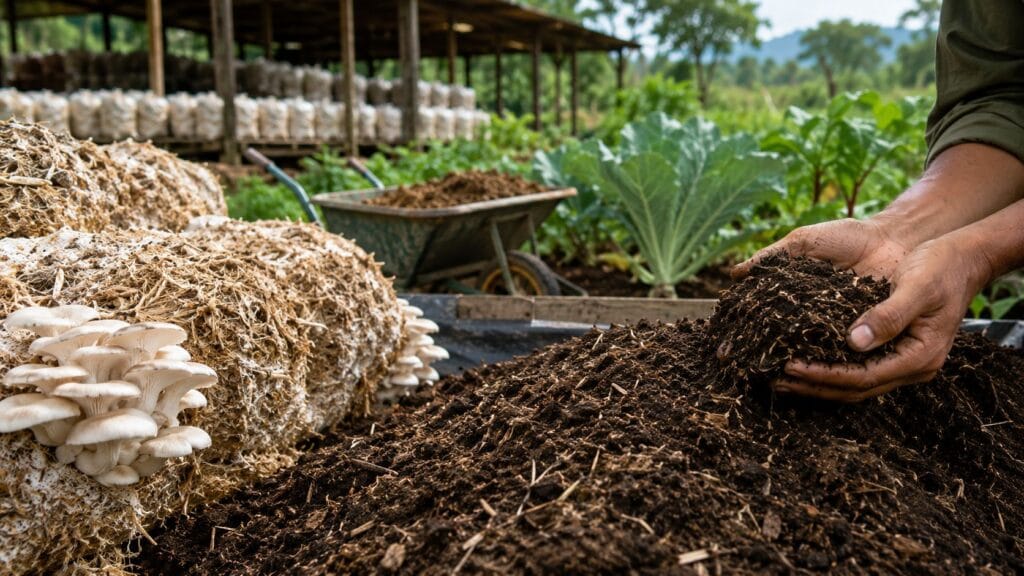
The circular opportunity does not necessarily end when mushrooms are harvested.
The material remaining after cultivation is generally known as Spent Mushroom Substrate (SMS). Its properties vary according to the mushroom species, original substrate, supplements, cultivation method, and post-harvest handling.
With appropriate processing and quality assessment, SMS can potentially become an input for additional agricultural or bio-based applications.
Spent Mushroom Substrate (SMS)
SMS still contains organic material after mushroom production.
Depending on its characteristics and local requirements, potential applications include:
- Composting
- Soil amendment
- Mulching
- Growing-media components
- Land restoration applications
Its suitability should be evaluated for the intended application rather than assuming all SMS has identical properties. The FAO’s resource on mushroom cultivation and circular use of agricultural residues offers additional background on linking mushroom production with residue utilization and soil-related applications.
Organic Fertilizer and Soil Amendments
Properly processed SMS can contribute organic matter to soils and may be incorporated into compost or soil-improvement products.
Potential benefits can include improved soil structure, water-holding properties, and organic matter recycling.
This creates a valuable circular pathway:
Crop Residue → Mushroom Production → SMS → Soil Amendment → Crop Production
Animal Feed: A Potential but Controlled Application
Some research has explored processed mushroom cultivation residues as components of animal-feed systems.
However, this application requires particular care. Suitability depends on factors including substrate composition, mushroom species, nutritional profile, contaminants, processing method, animal species, and applicable feed regulations.
SMS should therefore not automatically be treated as livestock feed without appropriate assessment.
Vermicompost Production
SMS can also be used as an input in suitable vermicomposting systems.
Earthworms and microorganisms further transform organic material into a stabilized soil amendment that can be used in horticulture, gardening, nurseries, and appropriate agricultural applications.
This adds another stage to the circular value chain rather than ending resource use immediately after mushroom harvest.
Bioenergy Potential
Mushroom cultivation residues are also being investigated for energy-related applications, including anaerobic digestion and other biomass-utilization pathways.
Commercial feasibility depends heavily on factors such as moisture content, transportation distance, available infrastructure, energy value, and processing requirements.
The broader opportunity is to view residual biomass as a resource stream to be evaluated, rather than automatically as waste.
Mycelium: Turning Biological Resources into Sustainable Materials
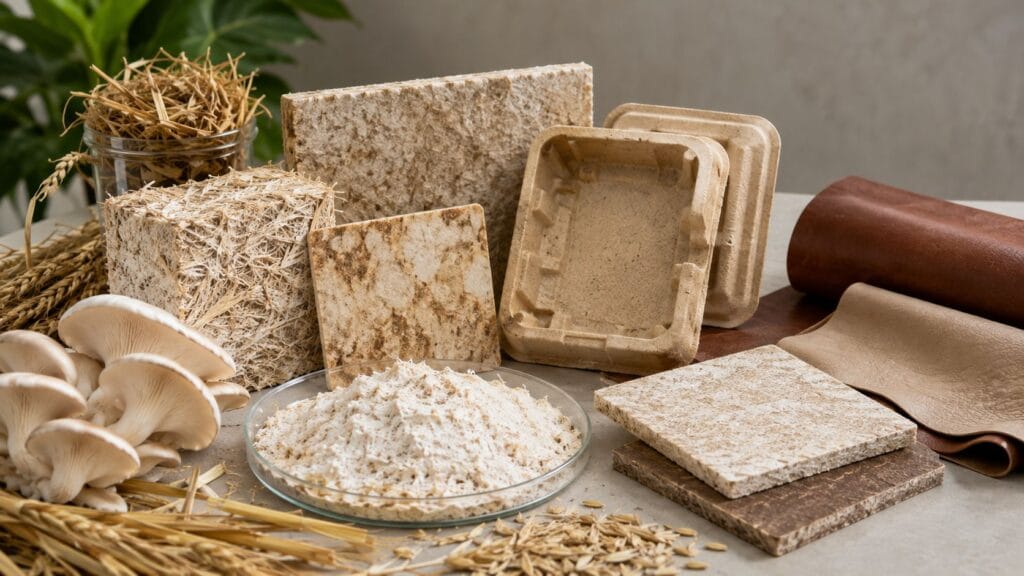
The circular potential of fungi extends beyond mushroom cultivation.
Mycelium can act as a natural binding network. Under controlled manufacturing conditions, it can grow through plant-based particles or fibers and bind them into engineered materials.
This has created an emerging category of mycelium-based biomaterials.
Mycelium-Based Packaging
One of the best-known applications is protective packaging.
Agricultural fibers or other suitable plant-based materials can be combined with selected fungal mycelium and grown inside molds. The mycelium binds the particles together, after which growth is stopped and the material is dried or otherwise processed.
Potential applications include protective packaging for:
- Electronics
- Consumer goods
- Furniture
- Industrial products
These materials are being explored as alternatives to some conventional petroleum-derived foams.
Mycelium Bio-Composites
Mycelium composites are also being researched and developed for:
- Interior products
- Decorative panels
- Furniture components
- Acoustic products
- Product design applications
Performance depends on formulation and manufacturing conditions, so mycelium composites should not be treated as universal replacements for conventional materials.
Their significance lies in demonstrating how biological growth can become part of manufacturing.
Mycelium-Based Leather Alternatives
Specialized fungal materials are also being developed for fashion and upholstery applications.
These materials can be engineered to provide leather-like characteristics and are being explored for products such as:
- Bags
- Footwear
- Accessories
- Upholstery
This represents a different technology pathway from simply using leftover mushroom substrate, but it belongs to the broader fungal bioeconomy.
Building and Insulation Materials
Researchers and companies are exploring mycelium composites for insulation, acoustic panels, and other non-structural or specialized building applications.
Properties such as density, strength, thermal performance, moisture resistance, and fire behavior depend strongly on how the material is engineered.
Mycelium therefore offers exciting potential, but commercial claims should always reflect the performance of the specific material rather than fungi in general.
Environmental Benefits of a Mushroom-Based Circular Economy
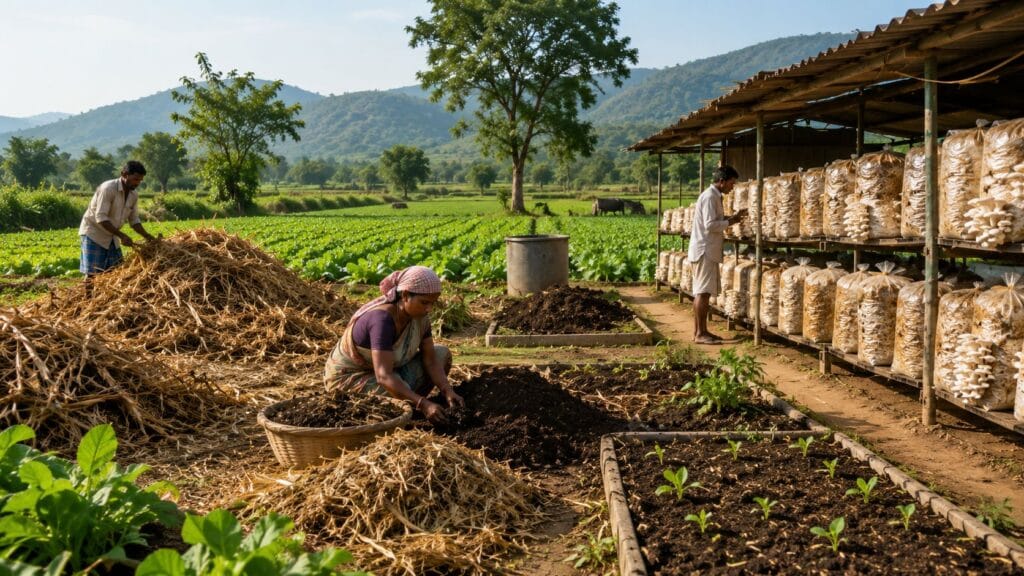
A well-designed mushroom-based circular economy can generate environmental benefits by extending the productive use of biological resources.
Reducing Agricultural Waste
Using suitable crop residues as mushroom substrates can provide an alternative productive pathway for agricultural biomass.
Where residues would otherwise be burned or poorly managed, creating a market for them can potentially reduce disposal pressure and encourage resource recovery.
Supporting Soil Health
Returning properly processed organic materials such as composted SMS to agricultural soils can help recycle organic matter.
Depending on its properties and application, this may contribute to:
- Soil structure
- Water retention
- Organic matter content
- Biological activity
Circular systems therefore have the potential to connect food production with soil restoration.
Potential to Reduce Environmental Burdens
Circular mushroom systems may reduce certain environmental burdens when they replace more wasteful alternatives—for example, diverting suitable residues from open burning or replacing some conventional materials with appropriately designed bio-based products.
However, environmental benefits should ideally be evaluated across the full lifecycle. Energy use, transportation, climate-control requirements, processing, and end-of-life treatment all influence the final impact.
Circular does not automatically mean impact-free.
Promoting Efficient Resource Utilization
The strongest environmental argument for mushroom-based circularity is resource efficiency.
One stream of agricultural biomass may contribute sequentially to:
Food Production → Organic Resource Recovery → Soil Improvement or Other Value-Added Applications
That means more useful value can potentially be obtained before a resource reaches the end of its productive life.
Supporting Regenerative Agriculture
Circular mushroom systems can complement regenerative agriculture by recycling organic matter, connecting different agricultural enterprises, and reducing unnecessary resource losses.
The objective is not simply to produce mushrooms sustainably but to build interconnected agricultural systems in which biological resources continually create value.
Business Opportunities in the Mushroom-Based Circular Economy
Circularity also creates economic opportunities.
Rather than depending on a single mushroom harvest as the only source of value, entrepreneurs can explore businesses across multiple stages of the value chain.
Commercial Mushroom Cultivation
The most immediate opportunity remains edible mushroom production. Growers exploring commercial production can also refer to our oyster mushroom cultivation guide.
Potential categories include:
- Fresh mushrooms
- Dried mushrooms
- Mushroom powders
- Seasonings
- Ready-to-cook products
- Other value-added mushroom foods
Locally available agricultural residues can potentially become part of the production model when technically suitable.
Compost and Soil-Input Businesses
SMS creates opportunities for businesses focused on:
- Compost
- Vermicompost
- Soil amendments
- Potting-media ingredients
- Organic resource recovery
Commercialization requires appropriate processing, quality control, regulatory compliance, packaging, and market development.
Mycelium-Based Products
The emerging fungal biomaterials sector creates opportunities in:
- Packaging
- Composites
- Interior products
- Fashion materials
- Specialized construction products
These opportunities are more technology-intensive than conventional mushroom farming and generally require dedicated R&D, material testing, and manufacturing capabilities.
Agricultural Residue Collection and Processing
Circular systems also require reliable supply chains.
Businesses can potentially specialize in:
- Biomass aggregation
- Residue collection
- Drying and storage
- Substrate preparation
- Processing and logistics
This can create an economic bridge between conventional crop farmers and mushroom enterprises.
Rural Entrepreneurship
A circular mushroom ecosystem can support multiple rural enterprises rather than one centralized business. For entrepreneurs planning a smaller entry point, our low-cost mushroom farming setup guide provides a practical starting framework.
Opportunities can exist in cultivation, spawn production, processing, composting, logistics, training, equipment, and value-added products.
The strongest models will be those where each enterprise solves a real problem for the next participant in the value chain.
Challenges to Building a Mushroom-Based Circular Economy
The concept is attractive, but creating a genuinely circular system requires more than finding uses for waste.
Agricultural Residue Collection
Agricultural biomass can be seasonal, dispersed, bulky, and expensive to transport.
A commercially viable system needs reliable solutions for:
- Collection
- Storage
- Moisture management
- Quality consistency
- Transportation
A technically usable residue is not necessarily an economically viable raw material.
Processing Infrastructure
Different stages of the circular value chain may require:
- Substrate preparation
- Pasteurization or sterilization
- Drying
- Composting
- Material processing
- Storage
- Quality testing
Without appropriate infrastructure, potentially valuable by-products may still end up being discarded.
Market Development
A product has value only if there is a customer willing to use it.
Markets must therefore be developed for outputs such as:
- Compost
- Soil amendments
- Processed mushroom foods
- Mycelium materials
This requires quality standards, product validation, customer education, distribution, and competitive pricing.
Technology and Skills
Circular mushroom enterprises require expertise across several disciplines, including:
- Mycology
- Food processing
- Agriculture
- Waste management
- Material science
- Quality assurance
No single technology automatically creates a circular business.
Investment and Policy Support
Infrastructure, R&D, demonstration projects, and commercialization all require investment.
Government agencies, research institutions, startups, farmers, manufacturers, and investors can each play a role in building viable circular value chains.
Building an Integrated Ecosystem
The biggest challenge—and opportunity—is integration.
A successful system may connect:
Crop Farmer → Biomass Aggregator → Mushroom Grower → Food Processor → SMS Processor → Compost/Fertilizer Enterprise → Farmer
Other fungal-material businesses may create additional value chains around mycelium and agricultural fibers.
Circularity becomes economically meaningful when these connections work reliably at commercial scale.
The Future of the Mushroom-Based Circular Economy
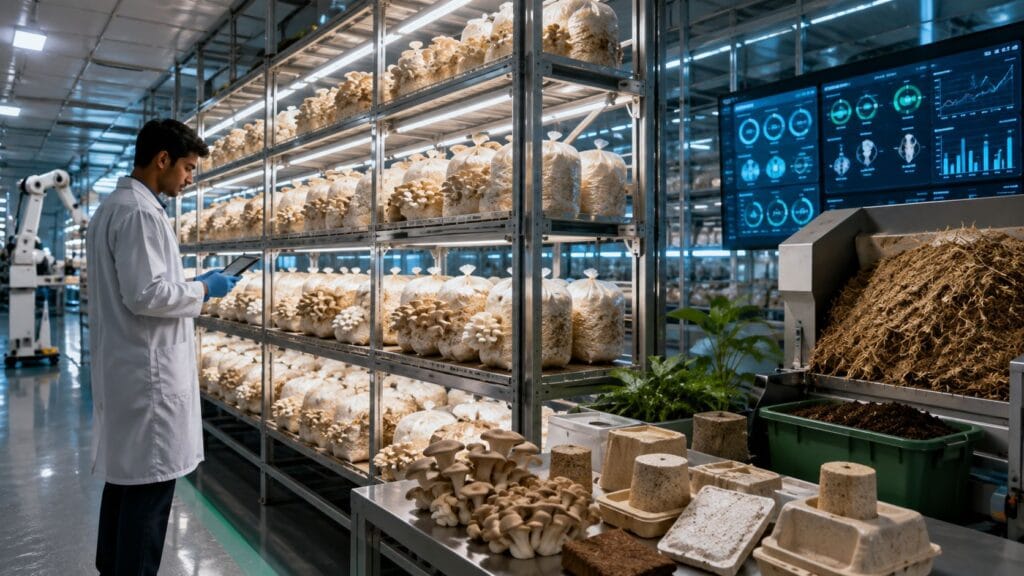
The future of mushroom-based circularity will likely be shaped by the convergence of agriculture, biotechnology, digital technology, and sustainable manufacturing.
Growth of the Bioeconomy
As industries search for renewable alternatives to fossil-based resources, biological materials are becoming increasingly important.
Mushrooms and fungal technologies can participate in this transition through food, agricultural inputs, biomaterials, and other bio-based applications.
Expansion of Mycelium Innovation
Research and commercialization of mycelium materials are likely to continue across packaging, fashion, interiors, and construction-related applications.
The most successful products will need to demonstrate not only sustainability but also competitive performance, safety, scalability, and cost.
Smarter Mushroom Farming
Technologies such as:
- Artificial Intelligence
- IoT sensors
- Automated climate control
- Data analytics
- Remote monitoring
can improve the efficiency and consistency of controlled mushroom cultivation. Learn more about IoT in mushroom farming and the broader role of AI in agriculture.
These technologies can complement circularity by helping growers optimize inputs and reduce avoidable resource losses.
Integration with Other Agricultural Systems
Future circular farms may connect crop production, mushroom cultivation, composting, renewable energy, and soil restoration more closely.
Instead of treating each activity as an isolated enterprise, integrated systems can allow the output of one process to become the input of another.
From Waste Management to Resource Management
Perhaps the most important change is conceptual.
Instead of asking:
“How do we dispose of agricultural waste?”
a circular economy asks:
“What useful value can we create from this resource next?”
That shift—from disposal to resource management—is at the heart of the mushroom-based circular economy.
Conclusion
The mushroom-based circular economy demonstrates how agriculture can move beyond a simple produce-and-dispose model.
Suitable agricultural residues can become substrates for mushroom cultivation. Mushrooms create food and economic value. Remaining cultivation materials can potentially be processed into compost, soil amendments, vermicompost, energy feedstocks, or other useful products. Separately, mycelium technologies are creating entirely new possibilities for bio-based materials.
The opportunity is therefore larger than mushroom production alone.
For farmers, entrepreneurs, researchers, manufacturers, and policymakers, mushroom-based circularity offers a framework for thinking differently about agricultural resources: what appears to be the end of one production cycle may actually be the raw material for the next.
Realizing that potential requires proper science, quality control, infrastructure, viable markets, and collaboration across the value chain. Not every residue can become every product, and not every circular application will be commercially or environmentally viable.
But when the system is designed carefully, mushrooms can help demonstrate a powerful principle for the future of agriculture:
Produce food. Recover resources. Create new value. Return useful biological materials to productive cycles—and waste as little as possible.
FAQs on Mushroom-Based Circular Economy
What is a mushroom-based circular economy?
A mushroom-based circular economy uses suitable agricultural residues and fungal processes to create food and other valuable products while keeping biological resources in productive use for longer and reducing waste.
How do mushrooms help recycle agricultural waste?
Many cultivated mushrooms can grow on prepared lignocellulosic materials such as straw and sawdust. Their mycelium breaks down components of this biomass and uses available nutrients for fungal growth and mushroom production.
What is Spent Mushroom Substrate?
Spent Mushroom Substrate (SMS) is the cultivation material remaining after mushroom production. Depending on its composition and processing, it may be suitable for composting, soil amendments, vermicomposting, and other applications.
Can mushroom cultivation waste be used as fertilizer?
Properly processed SMS can be used in compost and soil-amendment applications. Its suitability and nutrient characteristics depend on the original substrate, mushroom species, processing, and intended agricultural use.
What products can be made from mycelium?
Engineered mycelium materials are being developed for applications including protective packaging, composites, acoustic products, insulation, and leather-like materials.
Why are mushrooms useful in a circular economy?
Mushrooms can convert certain low-value biological materials into food, while fungal cultivation and mycelium technologies can create additional opportunities to recover value from renewable resources.
Is mushroom farming environmentally friendly?
It can contribute to more sustainable resource use, particularly when agricultural by-products are utilized efficiently. However, the total environmental impact depends on factors such as energy, water, transport, infrastructure, substrate sourcing, and waste management.
How does mushroom farming support sustainable agriculture?
Mushroom cultivation can utilize suitable crop residues, create food without requiring additional cropland for the mushroom substrate itself, and generate organic by-products that may be returned to productive agricultural systems.
Can small farmers benefit from a mushroom-based circular economy?
Potentially, yes. Small farmers and rural entrepreneurs can participate through mushroom cultivation, biomass supply, processing, composting, and other parts of the value chain. Commercial feasibility depends on local resources, markets, skills, and infrastructure.
What is the future of the mushroom-based circular economy?
Future growth is likely to involve better agricultural residue utilization, advanced mushroom cultivation, mycelium biomaterials, digital farming technologies, and stronger integration between agriculture, waste management, and the bioeconomy.

Leave a Reply